Share:


Table of Contents
Agentic commerce represents a transformative shift in eCommerce where AI agents autonomously handle shopping tasks on behalf of consumers, from product discovery to completing purchases. This evolution is crucial as it redefines how online stores must be structured and optimized to cater not only to human shoppers but also to intelligent software agents that drive purchasing decisions. • Agentic commerce allows AI agents to autonomously research, compare, and complete purchases without human intervention. • The effectiveness of agentic commerce relies on structured, machine-readable product data that AI agents can easily interpret. • Checkout processes must be streamlined to minimize friction, as any complexity can lead agents to abandon transactions. • Clear and accessible policies regarding returns, shipping, and payments are essential for AI agents to evaluate options effectively. • Investing in marketing automation can enhance store readiness for agentic commerce by enabling systems to act on customer behavior without human input. • As agentic commerce evolves, the quality of product recommendations will become increasingly important for both human and AI-driven shopping experiences.
The future of eCommerce isn’t coming someday. It’s already showing up in how people shop today.
Customers are starting to rely on AI tools not just to discover products, but to compare options, evaluate stores, and even make purchasing decisions on their behalf. Instead of manually browsing through dozens of tabs, AI agents can find the best option, check delivery timelines, review pricing, and place an order within seconds.
That shift is called agentic commerce, and it’s changing how online stores compete for visibility and sales.
For WooCommerce store owners, this creates a new challenge: your store no longer needs to appeal only to human shoppers. It also needs to be understandable to AI agents making decisions behind the scenes.
In this guide, we’ll break down what agentic commerce actually means, how AI shopping agents work, and what you can do to prepare your WooCommerce store for the next phase of online shopping.
Agentic commerce is eCommerce in which AI agents act on behalf of buyers, not just recommending options, but actively researching, comparing, and completing purchases.
The word “agentic” means the capacity to act independently. These aren’t rule-based chatbots that route customer service tickets or suggest related products. AI agents can reason through a goal, gather information across multiple sources, weigh trade-offs, and take action, such as placing an order, without navigating through a website.
You might also see it called “a-commerce.” Same idea.
The practical distinction is important. A chatbot waits for a user to ask a question and then responds. An agent receives a goal (“find me the best wireless keyboard under $30 with two-day delivery”) and autonomously pursues it. It doesn’t need a shopping interface to navigate. It doesn’t click through product carousels. It queries data directly, evaluates results, and acts.
That shift, from AI that assists to AI that acts, is what makes agentic commerce a structural change rather than a feature update.
Here’s a realistic walk-through of how an agentic commerce transaction plays out.
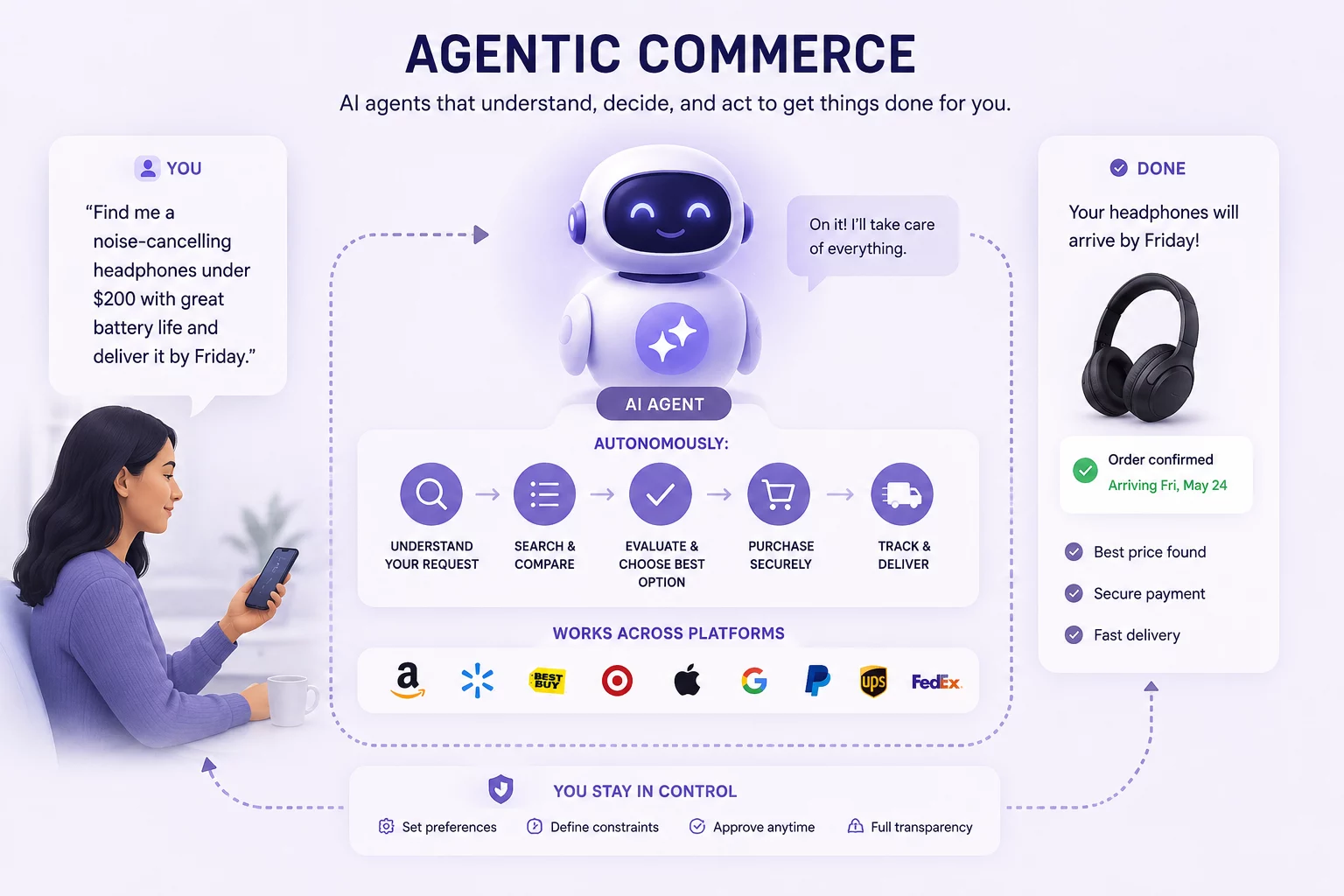
A shopper tells their agent: “Find me a noise cancelling headphones under $200 with great battery life and deliver it by Friday”.
The agent doesn’t open a browser and scroll through search results the way a person would. Instead, it queries product data directly from stores that have made their catalogs machine-readable. It checks availability, reads through return policies, pulls estimated delivery windows, and cross-references pricing.
Once it has evaluated the options, it surfaces a shortlist to the shopper. The shopper approves. The agent completes the checkout.
Three concepts are worth knowing to understand how this works technically.
- AI agents are autonomous software programs that use large language models (LLMs) to reason and act. They can follow complex instructions, weigh options, and transact — not just talk.
- Model Context Protocol (MCP) is the emerging standard that lets AI agents interact with a business’s data directly, rather than scraping web pages or simulating mouse clicks. Instead of navigating your storefront like a human would, an agent using MCP can query your product catalog, pricing, and checkout logic in a structured, machine-readable format. Think of it as the API layer that makes your store legible to agents.
- Agent-initiated payments are transactions where the agent completes the checkout on the buyer’s behalf, using pre-authorized credentials. The human doesn’t have to be at the keyboard when the purchase happens.
You don’t need to understand the technical architecture in depth. What matters is this: stores whose data is structured, whose checkout flows are clean, and whose policies are clearly defined will be the ones agents can actually buy from.
Most of what’s been written about agentic commerce focuses on the infrastructure side — payment rails, API protocols, enterprise platforms. That’s useful for developers. But if you run a WooCommerce store, the implications are a bit more grounded.
Discovery is changing
SEO has always been about making your store findable by humans through search engines. Now, a parallel layer is forming: making your store usable by agents. These aren’t the same thing. A beautifully designed category page with large images and intuitive filtering serves human shoppers well. An AI agent would rather have a structured product feed with complete specs, accurate pricing, and real-time stock levels.
This doesn’t mean abandoning your current site experience. It means that the stores that also invest in the machine-readable layer, product schema, complete attributes, and clean data will increasingly have the advantage as agentic shopping grows.
Checkout friction becomes a bigger problem
Agents are transacting on behalf of buyers who have authorized them to complete purchases. Any checkout flow that requires unexpected input, a required account creation, a CAPTCHA, or a confusing promo code field creates a failure point.
Agents deprioritize or abandon stores where the purchase can’t be completed cleanly. The friction that merely annoys human shoppers will reliably block agent-driven ones. Ensure you fully understand how agentic checkout works, and update your integration to allow agents to seamlessly complete transactions on behalf of buyers.
Product data quality is the new storefront quality
Incomplete product descriptions, missing dimensions, vague shipping estimates, or outdated pricing aren’t just bad UX; they’re disqualifying signals for agents evaluating options.
An agent trying to answer “Does this ship in two days?” can’t proceed if the shipping information isn’t clearly structured. That sale goes to the store that answered the question cleanly.
The buyer is still human
Agents act on behalf of real people with real preferences. That means your pricing strategy, your return policy, your trust signals, all of it still matters. The difference is that those elements now need to be as readable to a machine as they are to a person.
This isn’t only a future-tense topic. Agentic commerce is showing up in several forms right now.
- AI shopping agents are the most visible example. Tools like ChatGPT, Perplexity, and Google’s AI-powered search already surface product recommendations and, increasingly, help users complete purchases. When someone asks an AI assistant for the best running shoes in a given price range and gets a direct answer with a buy link, that’s early agentic commerce in action.
- Automated replenishment is a B2B use case that’s already well-established. An agent monitors inventory levels and automatically reorders supplies when stock drops below a threshold, without waiting for a human to notice the gap. For wholesale and subscription-based stores, this is practical and in use today.
- Personalized product discovery gets more sophisticated with agents. Instead of a recommendation engine suggesting “customers who bought this also bought…”, an agent can reason through multiple data points simultaneously: purchase history, current intent, available budget, preferred brands, and even external context like upcoming events or weather. The result is a recommendation that fits the full picture, not just past behavior.
- Post-purchase agents handle the operational tail of an order: tracking updates, return initiation, review prompts, and reorder suggestions. For store owners, this means customer service load can decrease while the post-purchase experience improves. An agent can proactively update a buyer about a delayed shipment rather than waiting for the customer to contact support.
- Merchant-side agents are the other half of the equation. These are agents working for the store owner rather than the buyer. A merchandising agent might monitor which products are underperforming and automatically generate a targeted promotion for the relevant customer segment. Another might scan customer reviews of a product and update the description to address common questions before they even get asked. Salesforce’s Agentforce platform is already building tools in this direction for enterprise retailers.
For WooCommerce store owners, the merchant-side application is where the immediate opportunity sits.
Tools that automate email sequences based on behavior, generate targeted coupon campaigns for specific customer groups, and trigger post-purchase flows based on order data are the early versions of this capability. They’re not as autonomous as a full agent, but they operate on the same logic: act on data, without waiting for human input.
Also Read: How to Make Your WooCommerce Store AI-Ready
Gartner estimates that 33% of enterprises will have agentic AI capabilities by 2028. That’s a substantial adoption curve over a short window, and it will quickly raise buyers’ expectations for shopping experiences.
The next phase beyond individual buying agents is agent-to-agent commerce: a merchant’s pricing or inventory agent negotiating with a buyer’s purchasing agent, without a human involved on either side. That’s further out. But the infrastructure decisions being made now will determine which stores are positioned for it.
What’s clear already: the stores that win in an agentic commerce environment aren’t necessarily the ones with the biggest budgets or the most sophisticated tech. They’re the ones with clean data, frictionless checkout, and systems that can automatically act on information.


Subcribe to our newsletter