Share:


Table of Contents
Quick commerce, or q-commerce, is a delivery model that provides everyday products within 10 to 30 minutes of order placement, significantly faster than traditional eCommerce, which typically takes 1 to 7 days. This model operates through dark stores located close to customers, focusing on high-frequency, low-consideration items, making it essential for D2C brands to assess their product fit and the associated trade-offs before engaging with this channel.
- Quick commerce relies on dark stores that stock fast-moving consumer goods to enable rapid delivery.
- It is primarily driven by urban demand, with North America being the largest market for quick commerce services.
- Brands must navigate higher commission rates and reduced control over customer data when selling through quick commerce platforms.
- The model favors products with high repeat purchase rates and low consideration time, such as snacks and personal care items.
- Quick commerce can serve as an acquisition channel, but brands should treat it as a complement to their existing D2C strategies rather than a replacement.
- Careful evaluation of product fit, margin sustainability, and supply reliability is crucial for success in the quick commerce landscape.
Your D2C brand has a website, a decent ad budget, and a checkout that works. Then a customer asks why they can’t get your product delivered in fifteen minutes through Gopuff, Zapp, or Amazon Fresh. Quick commerce isn’t a delivery upgrade you can bolt onto your existing setup. It’s a different channel, with different economics.
In this article, we will explain everything you need to know about quick commerce.
Let’s get started.
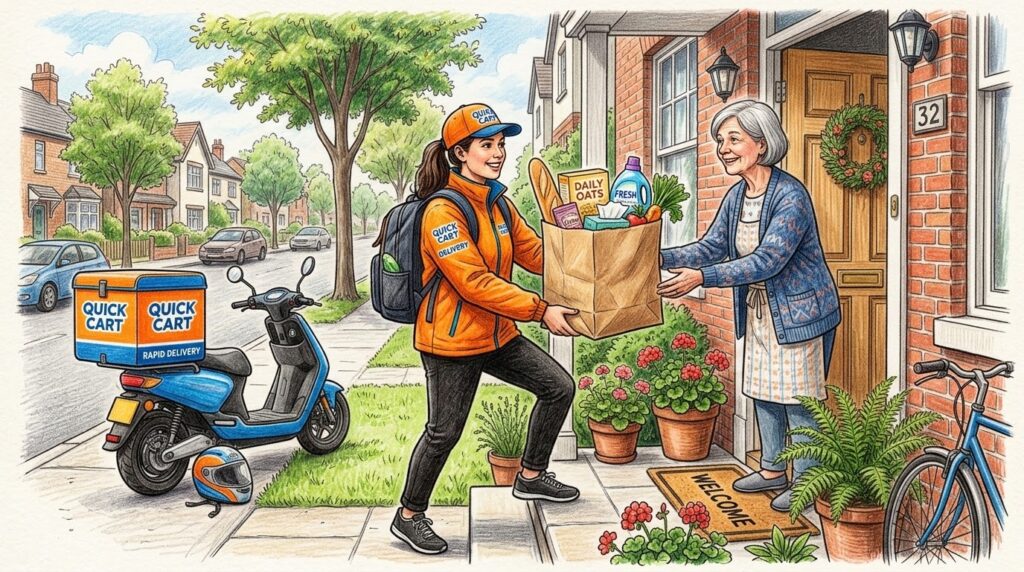
Quick commerce (often shortened to q-commerce) is the delivery of everyday products, typically groceries, personal care, snacks, and small household items, within 10 to 30 minutes of an order being placed. Traditional eCommerce, the kind your WooCommerce or Shopify store runs on, works on a completely different clock: 1 to 7 days from order to doorstep.
The difference isn’t just speed. Traditional eCommerce ships from a central warehouse and can carry your entire catalog. Quick commerce ships from a dark store, a small local fulfillment point stocked only with fast-moving items, within a couple of kilometers of the customer.
North America is already the largest regional market for quick commerce, accounting for roughly a third of global revenue, with Gopuff as the dominant player across major US cities. The UK market was valued at close to $2.83 billion in 2025 and is on track to reach around $4.22 billion by 2031, growing at a steady, if unspectacular, high single-digit rate.
London alone supports half a dozen competing services (Gopuff, Amazon Now, Tesco Whoosh, Deliveroo’s Hop, and Zapp, among them), which tells you how concentrated the demand is in dense urban centers rather than spread evenly nationwide.
That growth didn’t come from expanding the product range. It came from urban shoppers reordering the same categories, groceries, snacks, personal care, over-the-counter essentials, again and again, at a frequency traditional eCommerce never captured.
If your product fits one of those categories, the audience is already there and already spending. If it doesn’t, the growth numbers are somebody else’s story, not yours. More on that distinction below.
Every quick commerce platform runs on the same basic mechanics:
- Dark stores: small warehouses inside residential and commercial zones, invisible to walk-in customers, built purely for fast picking and dispatch.
- A tight delivery radius: usually 2 to 3 kilometers, which is what makes sub-30-minute delivery physically possible.
- A curated SKU list: dark stores stock only fast-moving items. Slow sellers get cut, not because they’re bad products, but because shelf space near the customer is the scarcest resource in the whole model.
- Demand-driven restocking: inventory decisions run on an algorithm based on recent order velocity in that specific zip code or postcode, not a merchandiser’s judgment call.
This is why quick commerce can’t just be “eCommerce, but faster.” A warehouse three states away can carry ten thousand SKUs profitably. A dark store two kilometers from a customer can’t. Every product placed there is competing for a shelf that has to earn its rent multiple times a day.
The field looks different depending on which side of the Atlantic you’re selling into.
| Platform | Type |
| Gopuff | Vertical specialist, runs its own dark stores |
| DoorDash | Multi-vertical delivery platform, grocery is one category among many |
| Instacart | Grocery-focused marketplace, partners with existing retailers |
| Walmart Express | Retailer-led, built on Walmart’s existing store network |
| Amazon Now / Amazon Fresh | Retailer-led, Amazon’s own fulfillment |
| Tesco Whoosh | Retailer-led, runs out of existing Tesco stores |
| Deliveroo (Hop) | Multi-vertical platform extending into the grocery |
| Zapp | Vertical specialist, dark-store only |
Each platform runs its own onboarding process, its own commission structure, and its own category priorities. Getting listed on Gopuff doesn’t get you listed on Instacart, and a Tesco Whoosh listing has nothing to do with Amazon Now.
You’re negotiating with each one separately, and each one will want proof that your product moves fast enough to justify the shelf space. It’s also worth remembering that this field has already consolidated once, which is a bigger issue than it first sounds. More on that below.
This is the part most quick commerce explainers skip, and it’s the part that actually determines whether this channel is good for your brand.
Margin
Platform commissions on quick commerce typically run higher than what you’d pay a payment gateway or ad platform for an equivalent sale on your own site. You’re not just paying for the order. You’re paying for shelf placement, dark store handling, and last-mile delivery that you don’t control.
Brand Control
On your own WooCommerce or Shopify store, you control the product page, the checkout experience, and every email or notification that follows. On a quick commerce platform, your product is a tile in someone else’s app, next to a dozen competitors, with pricing and promotions the platform can adjust without asking you.
Customer Data
This is the one that matters most long-term. A sale through your own store gives you an email address, a purchase history, and the ability to run a WooCommerce abandoned cart recovery flow or a personalized marketing automation sequence the next time that customer is close to buying again. A sale through Gopuff or Zapp gives the platform that data. You get the revenue line, not the relationship.
That last point is why quick commerce works best as an acquisition and visibility channel, not a replacement for your own store. It puts your product in front of people who’d never have found you otherwise. What you do with that visibility, driving some of those customers back to your own site where you own the data and the repeat relationship, is where the actual D2C strategy lives.
Pro Tip:
Include a card insert or QR code in your quick commerce packaging that leads to your own site, with a small incentive for signing up there. It won’t convert every buyer, but it turns some anonymous platform sales into named customers you can market to directly through a personalized recommendation or a win-back email later on.
Not every D2C category belongs here, and pretending otherwise is how brands end up paying commission on a channel that never earns its keep.
Quick commerce rewards products with high repeat frequency and low consideration time: personal care refills, snacks, basic grooming, and over-the-counter health items. These are purchases a customer makes on impulse or out of routine, not ones they research for a week first.
It works against products that require comparison, explanation, or a considered decision: skincare with an ingredient story to tell, apparel where fit and returns matter, electronics accessories, anything priced high enough that a customer wants to read reviews first. If your product page is doing real persuasion work right now, a ten-second glance at a dark store app tile isn’t going to replicate that.
Some brands split the difference by putting only their simplest, most habitual SKU on quick commerce (a travel-size version, a single hero variant) while keeping the full range, with its comparison charts and detailed descriptions, on their own store. That way, the platform sale acts as a low-friction sample of the brand rather than an attempt to sell your most complex product through a channel that was never built to explain it.
Before agreeing to a listing, run your product against these questions honestly:
- Repeat rate: Does a customer buy this again within weeks, not months? If not, quick commerce’s frequency advantage doesn’t apply to you.
- Margin room: Can you absorb platform commission and still turn a profit at the price point customers expect in a quick commerce app, which tends to be lower than your own site’s pricing?
- Supply reliability: Can you keep a dark store stocked without stockouts? A single bad week gets you deprioritized fast, since restocking decisions are algorithmic and unforgiving.
- Category fit: Is this an impulse or routine purchase, or does it need explanation your own product page currently provides?
- Data trade-off: Are you comfortable trading customer data ownership for distribution reach, at least for this specific product line?
If most of your answers point in one direction, the decision is easier than it feels from the outside. Brands that say yes without checking margin and supply reliability are usually the ones quietly pulling out six months later.
Three problems show up across almost every honest account of quick commerce in the US and UK, and none of them are going away soon.
Profitability Pressure
Getir’s 2024 exit from both the US and UK, and Gorillas’ folding into Getir before that, weren’t isolated failures. Deep discounts and free delivery fueled early growth across this category, but they also drove up customer acquisition costs that the platforms themselves couldn’t sustain. That pressure doesn’t stay with the platform. It gets passed down to sellers through tighter commission terms and pressure to fund promotions out of your own margin.
Discount-driven Loyalty
Customers switch apps for a couple of dollars or pounds off a delivery fee. That’s a platform-level problem, but it affects you too: the customer buying your product through Gopuff or Tesco Whoosh today has weak loyalty to the platform, and even weaker loyalty to your brand specifically, since they never interacted with your site at all.
Inventory Risk at the Edge
Matching stock to hyperlocal, neighborhood-level demand is genuinely hard, even with good forecasting tools. A stockout at a single dark store looks like a small operational hiccup from the platform’s side. From your brand’s side, it’s a customer who searched for you, didn’t find you, and bought a competitor’s product sitting right next to where yours should have been.
Is Amazon Fresh quick commerce?
Amazon Fresh and the newer Amazon Now service both deliver groceries fast, but only Amazon Now is built specifically around the sub-30-minute quick commerce model. Amazon Fresh has traditionally run on same-day or scheduled delivery windows.
Is Instacart quick commerce?
Instacart is closer to a grocery marketplace than a pure quick commerce play. It partners with existing supermarkets rather than running its own dark stores, and delivery windows vary by retailer rather than guaranteeing a fixed 10 to 30-minute promise.
What happened to Getir in the US and UK?
Getir shut down its US and UK operations in 2024 after acquiring Gorillas the year before. It’s the clearest example of how competitive and capital-intensive this category is, even for well-funded players.
How is quick commerce different from same-day delivery?
Same-day delivery still works on a warehouse-to-doorstep model over several hours. Quick commerce compresses that into minutes by stocking inventory inside the delivery radius itself, through dark stores, rather than shipping it in after the order is placed.
Quick commerce isn’t replacing traditional eCommerce. It’s creating another channel with its own strengths, constraints, and economics. For the right products, it can increase visibility, reach new customers, and generate repeat purchases that might never happen through a standalone online store. For others, the commissions, limited product selection, and loss of customer data may outweigh the benefits.
The key is to treat quick commerce as part of a broader D2C strategy rather than the strategy itself. Evaluate whether your products fit the model, understand the trade-offs before signing up, and use the channel to complement your own WooCommerce or Shopify store, where you retain control over your brand, customer relationships, and long-term growth. Done thoughtfully, quick commerce can become a valuable addition to your sales mix instead of an expensive distraction.


Subcribe to our newsletter