



Share:


Table of Contents
BigCommerce's 2026 pricing changes have prompted small businesses to reevaluate their eCommerce platform choices due to increased costs and stricter revenue caps. As businesses face automatic plan upgrades and new transaction fees, exploring alternatives can provide better value and flexibility tailored to their unique needs.
- The June 2026 pricing update reduced revenue caps and introduced transaction fees, significantly impacting small businesses.
- WooCommerce offers a cost-effective, customizable solution without revenue-based pricing tiers, ideal for those with technical skills.
- Shopify provides a fully managed platform that simplifies setup and maintenance, though costs can escalate with additional app subscriptions.
- Wix and Squarespace cater to users prioritizing design and ease of use, but may struggle with scalability and complex inventory management.
- Ecwid allows businesses to add eCommerce functionality to existing websites, making it a low-cost entry point for online selling.
- Square Online integrates seamlessly with physical retail operations, making it suitable for businesses selling both online and in-person.
If you run a small store on BigCommerce, June 1, 2026 probably changed your math. Every plan got a new name, the revenue caps that decide your tier dropped, and orders processed through a payment gateway outside BigCommerce’s approved list now carry a fee of up to 2%. For a store doing $40K a year, that can mean being moved off the entry plan and paying almost three times as much each month, before any new fees.
That makes this a good time to look at BigCommerce alternatives. This guide covers seven platforms that work well for small businesses. For each one, it explains what it costs at your size and where it falls short. It also covers what it takes to move your products, customers, coupons, and gift cards without losing sales or search rankings.
BigCommerce has always tied its plans to revenue, so the more you sell, the higher your tier. The June 2026 plan and pricing update tightened that model in several ways that hit smaller stores directly.
- Plans Got New Names: Standard is now Core, Plus is now Growth, Pro is now Scale, and Enterprise is now Performance.
- Revenue Caps Dropped: Core now tops out at $30,000 in trailing 12-month sales, down from $50,000. Growth caps at $100,000, down from $180,000. Cross a cap and the upgrade happens automatically. With Core at $39 a month and Growth at $105, a store that passes $30K pays roughly 2.7 times more for the same platform.
- A New Transaction Fee: Orders paid through a gateway outside BigCommerce’s Embedded Payment Providers list now carry an Open Payment Provider Fee of 2% on Core, 1% on Growth, and 0.6% on Scale. If your store depends on a regional or specialty gateway, that cost grows with every order.
- Less Support and a Few Hard Limits: Phone support is no longer included on Core. Products are still capped at 600 variants each, which can be a problem for apparel and configurable products.
Not every store needs to move, though. BigCommerce lists more than 20 fee-free payment providers. If you already use one of them and sit comfortably below your plan’s cap, staying put can still make sense. Everyone else should compare what the same store would cost on another platform.
1. WooCommerce
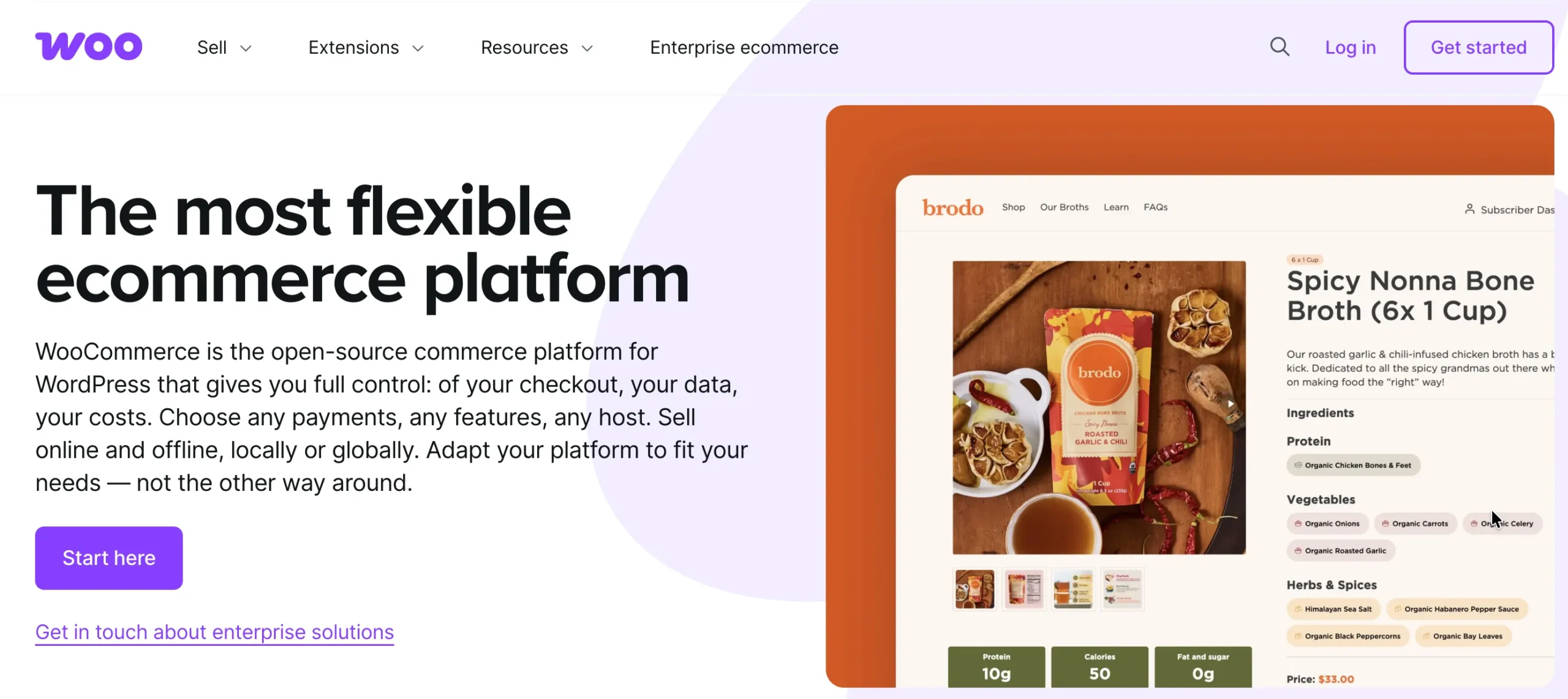
WooCommerce is a free, open-source plugin that turns a WordPress site into a full online store. It’s a natural fit for small businesses that already use WordPress or want complete control over their costs, payments, and data. Because the software itself is free, you pay only for what your store actually uses: hosting, a domain, payment processing, and any premium extensions you add along the way.
The biggest difference in a BigCommerce vs WooCommerce comparison is ownership. There are no revenue tiers, so passing $30K or $100K in sales never pushes you into a pricier plan. You can use any payment gateway WooCommerce supports without a platform fee stacked on top, and your products, orders, and customer data live on hosting you choose. The extension ecosystem covers coupons, gift cards, subscriptions, email marketing, and almost anything else a growing store needs.
That flexibility comes with responsibility. You handle hosting, updates, backups, and security yourself. Small teams can keep this manageable with a managed WooCommerce host that takes most of the routine maintenance off their plate.
2. Shopify

Shopify is a fully hosted eCommerce platform built for merchants who want to launch quickly without dealing with servers or software updates. Security, performance, and checkout are handled for you, which makes it one of the most common choices for new stores and small teams that would rather spend their time on products and marketing than on technical upkeep.
Its app store is a major draw. Reviews, loyalty programs, subscriptions, upsells, and shipping tools are all a few clicks away, so a small store can add features as it grows. Plans are chosen by features rather than sales caps, which means higher revenue doesn’t trigger an automatic upgrade. Shop Pay also gives you a fast checkout that many shoppers already recognize and trust.
The trade-off is cost creep. App subscriptions add up quickly once you stack a few, and using a third-party payment gateway instead of Shopify Payments adds a transaction fee. URL structures for products and collections are fixed, which limits some SEO control. Pricing is a monthly subscription by plan, plus payment processing and any paid apps.
3. Wix
Wix is a website builder with eCommerce features layered on top, which makes it a good match for small brands that want their site and store managed in one place. Its drag-and-drop editor gives you control over every page layout without writing code, so you can shape your storefront exactly the way you picture it.
Beyond design, Wix includes blogging, bookings, and email marketing tools inside the platform. That means fewer third-party add-ons to set up and pay for when you’re getting started. For a store selling a few dozen products with a strong visual identity, it can feel easier to run than BigCommerce, and most small businesses can move from signup to their first sale fairly quickly.
Where Wix struggles is scale. It isn’t designed for large catalogs, and complex shipping rules, multi-region tax setups, and custom checkout flows are limited. Its app market is also smaller than Shopify’s. Pricing works through monthly plans, with selling features available on its business tiers, plus payment processing fees.
4. Squarespace

Squarespace is known for polished, design-led templates that make even a one-person brand look professional from day one. It suits creatives, boutiques, and service businesses where presentation matters as much as the products themselves. You can launch a good-looking store without hiring a designer or touching code.
The platform handles more than physical products. You can sell digital downloads, services, memberships, and subscriptions from the same site, and scheduling tools make it easy to take bookings alongside sales. Built-in email campaigns pull in your branding automatically, which helps small teams keep marketing consistent without extra software. If brand presentation and services matter more to you than catalog depth, Squarespace can be a better fit than BigCommerce.
The limits show up with complex inventory. Stock management is basic, integrations are fewer than on dedicated eCommerce platforms, and deep customization isn’t really an option. Stores with hundreds of SKUs and many variants will feel boxed in. Pricing is through monthly plans, with selling features and transaction fees varying by plan, plus payment processing.
5. Ecwid
Ecwid takes a different approach from the other platforms on this list. Instead of replacing your website, it adds a store to the one you already have. It embeds into WordPress, Wix, Squarespace, or even a custom HTML site, so you can start selling without rebuilding pages, redesigning your brand, or moving your content.
That makes Ecwid useful for small businesses that are happy with their current website but want a simpler, lower-cost way to sell. You can also list products on social channels and marketplaces from the same dashboard, which keeps inventory and orders in one place. Its free plan for very small catalogs makes it a common pick for anyone looking for a free BigCommerce alternative to test before committing.
Keep in mind that Ecwid is a store, not a full website builder. Design control is limited unless you’re comfortable editing CSS, and useful features like abandoned cart emails sit on paid tiers. Pricing starts with a free plan for tiny catalogs, then moves to monthly paid tiers, plus payment processing.
6. Square Online
Square Online is built for small businesses that sell both in person and online, such as retail shops, cafes, bakeries, and market sellers. Its main strength is the connection to Square’s point-of-sale system. Inventory, orders, and customer records sync between your physical counter and your online store, so you’re not juggling two separate stock counts.
For local businesses, the built-in pickup and local delivery options are especially practical. Customers can order online and collect in store, which helps you capture sales from people who already know your shop. Setup is quick, and a free plan lets you get online without a monthly commitment, which is useful when you’re testing whether online sales are worth the effort.
Square Online works best when you process payments through Square, and it’s less suited to large, online-only catalogs. Design flexibility and SEO controls are lighter than on dedicated ecommerce platforms. Pricing includes a free plan, paid plans that unlock more features, and per-transaction processing fees through Square.
7. PrestaShop
PrestaShop is a free, open-source eCommerce platform that appeals to small teams with some technical skill, especially those selling across several countries. Multiple languages and currencies are supported out of the box, which makes it a practical choice for stores serving customers in Europe or other multilingual markets without stitching together extra tools.
A large marketplace of modules and themes lets you extend the store as your needs grow, and full code access means you’re never boxed in by a vendor’s roadmap or pricing changes. Like WooCommerce, you own your data and choose your own hosting, so there are no platform-imposed revenue tiers or payment provider fees to plan around.
The trade-off is effort. You’ll need your own hosting and usually a developer for setup and ongoing maintenance, and the learning curve is steeper than any hosted option on this list. Premium modules are sold individually, so costs can climb as you add features.
BigCommerce’s 2026 pricing changes have made it worth reconsidering whether the platform still offers good value for small businesses. With lower revenue caps, automatic plan upgrades, and additional payment provider fees, growing stores may find themselves paying more without getting much in return.
The right BigCommerce alternative depends on what matters most to your business. WooCommerce offers greater control over costs, payment gateways, and store customization without revenue-based pricing tiers. Shopify is a strong choice for businesses that prefer a fully managed platform, while Wix and Squarespace work well for smaller stores that prioritize simplicity and design. Ecwid, Square Online, and PrestaShop also offer practical advantages for specific business needs.
Before making the switch, compare the total cost of running your store, including hosting, extensions, transaction fees, and maintenance. More importantly, plan your migration carefully to preserve your products, customer data, order history, and SEO rankings. The goal isn’t simply to find a cheaper alternative to BigCommerce, but to choose an eCommerce platform that supports your business as it grows.


Subcribe to our newsletter


