Share:


Table of Contents
A GDPR-compliant cookie policy requires websites to obtain explicit and informed user consent before placing non-essential cookies. This process involves displaying a cookie consent banner with clear Accept, Reject, and Settings options, avoiding pre-ticked boxes, and explaining cookie usage in plain language. Users must be informed about what types of cookies are used, such as essential, analytics, marketing, and third-party cookies, why they are used, how long they remain active, and how consent can be withdrawn at any time.
The key requirements of a GDPR-compliant cookie policy include defining what cookies are, explain their types and purposes, list third-party cookies used on the site, and outline how user data is handled. Presenting this information in a structured and transparent way helps ensure compliance. You can easily generate GDPR compliant cookie policy for your WordPress websites using WebToffee’s cookie consent plugin.
In this article, we will look into what a GDPR cookie policy is, outline the major requirements for creating a GDPR-compliant cookie policy on your website, and also how to generate a compliant cookie policy for your WordPress website.
Key Takeaways
- GDPR requires websites to clearly inform users about cookie usage and obtain consent before loading non-essential cookies.
- A cookie policy is a legal document that explains to your users about cookies used on your website.
- A GDPR-compliant cookie policy should describe cookie types, purposes, third-party cookies, and consent management options.
- You can easily generate a GDPR compliant cookie policy for WordPress using the WebToffee Cookie Consent plugin.
A cookie policy is a legal document that explains to your users about cookies used on your website. Major cookie laws like GDPR and CCPA require website owners to inform visitors about the cookie usage on their websites.
Cookies are small pieces of information stored in the users’ browsers for various purposes like saving credentials and preferences, tracking user activity on the internet, for analytical and advertising purposes.
You are not required to have a dedicated cookie policy page for your website to comply with GDPR. Some website owners add cookie policies to the privacy policy page of their websites. But if you are using a lot of cookies on your website, it is recommended to have a GDPR compliant cookie policy explaining every cookie and its functionality in detail.
The General Data Protection Regulation (GDPR) requires users’ informed consent before loading cookies on their browsers. You should add a cookie consent banner to obtain prior consent from your website visitors.
You should add a cookie policy on your website and give links to the cookie policy page on the banner. The GDPR cookie policy should explain every cookie used on the website and its purpose in detail. It is not allowed to load any cookies other than the essential cookies on your website visitors’ browsers without their consent.
Now let’s see what are the major requirements for a GDPR compliant cookie policy.
A GDPR-compliant cookie policy must clearly explain how your website uses cookies and other tracking technologies, in a way that is transparent and easy for users to understand. Beyond simply mentioning cookies, the policy should help visitors make informed decisions by explaining what data is collected, why it is collected, and how they can control their preferences.
Below are the key elements every GDPR cookie policy should include to meet transparency and user consent requirements.
1. Brief Explanation About “What Are Cookies”
You should give a brief explanation about what are cookies and why are they used. Your website visitors may not have proper knowledge of cookies. Maybe the only cookie they know is that crunchy choco chipped one baked in an oven. So it is your responsibility to clearly explain to them about web cookies and why it is used.
2. Types of Cookies Used and How You Use Them
Explain the different types of cookies used on your website and how you use them. You don’t need to list all the cookies used one by one, but it is essential to let the users know what cookies are used on your website and how you use them.
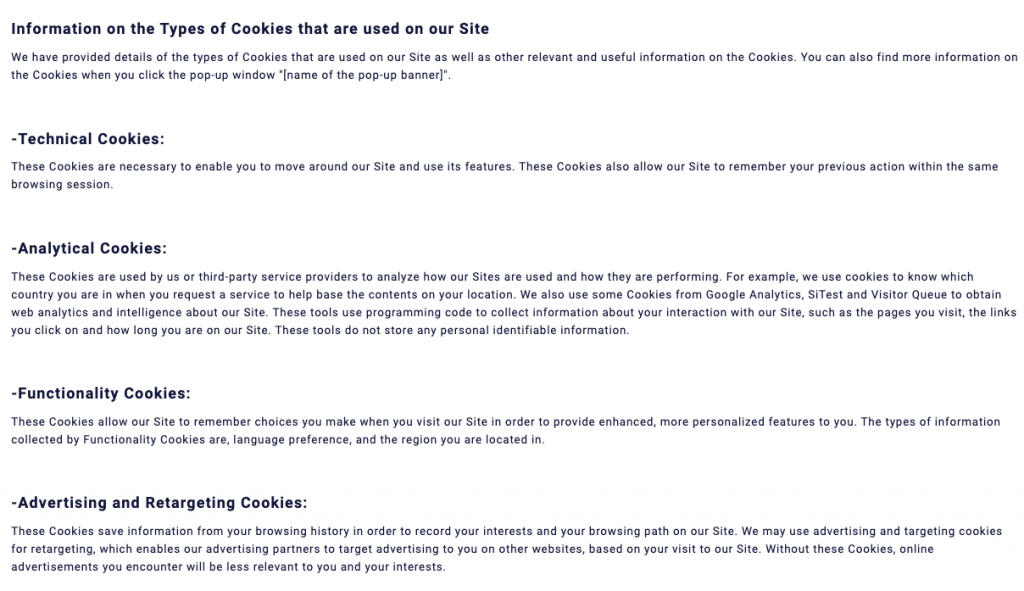
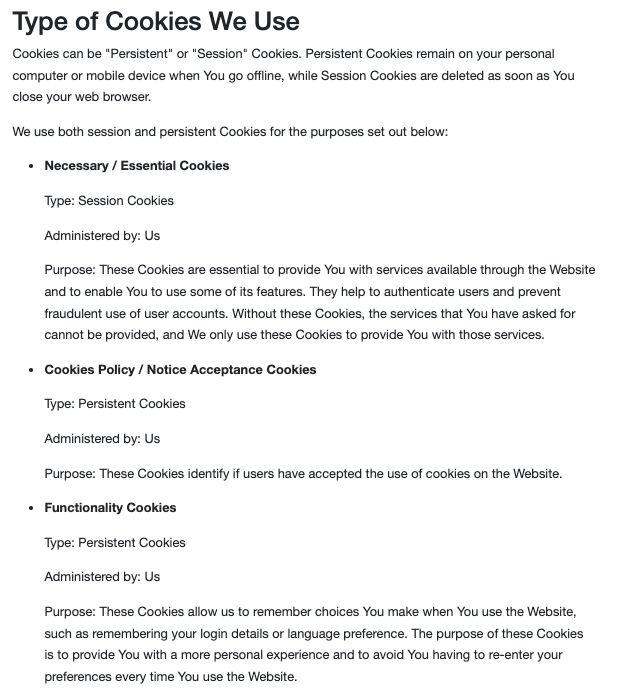
The following screenshots illustrate how websites display the types of cookies used. You can explain the types and purposes of cookies used in descriptive format like shown below:
Or, list the cookie types and their use in an easy to understand manner like shown below:
Or, showcase cookie types in a tabular format.
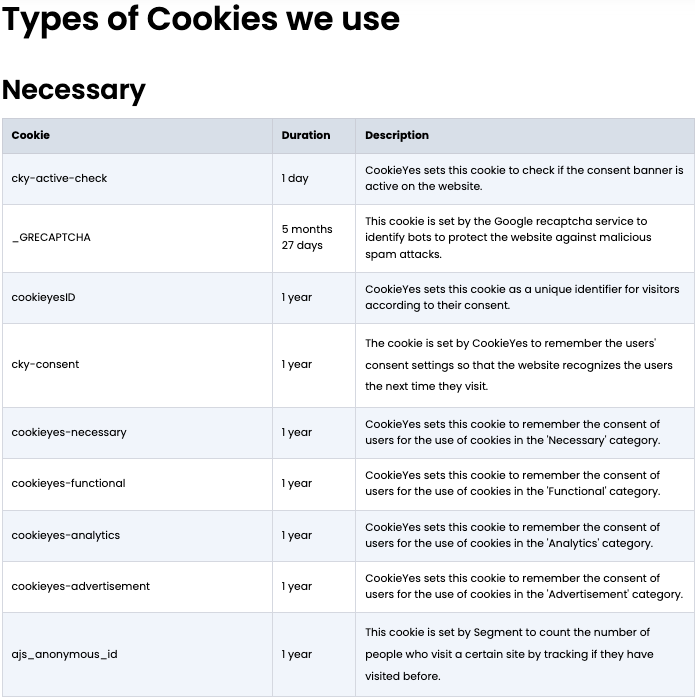
The bottom line is to explain the types of cookie used and why they are being collected to the users in a clear and simple manner.
3. Inform the Use of Third-Party, Analytical, and Remarketing Cookies
If your website uses third-party cookies, analytical or remarketing services like Google Ads, you have to inform your users using the cookie policy. The cookie policy should include essential details like the purpose of the cookies, what data they collect, how they process the data, etc.
4. Inform the Use of Other Trackers
Your website may use various tracking technologies like web beacons or pixel tags to track user activity on your website. Even though they are not cookies, they interact with web cookies for tracking user data. So it is important to disclose the use of any such tracking technologies on your website.
5. Provide Instructions for Disabling Cookies
While obtaining prior consent for cookie use is important, it is also important to let users know how to opt out of cookies. Your website cookie policy should have proper instructions on how to disable cookies for users. In addition, users should be given the option to revisit their consent at any time.
Also Read: Right of Withdrawal in WooCommerce
Now that you understand what a GDPR cookie policy is and its essential components, let’s move on to how you can generate a GDPR-compliant cookie policy in WordPress.
We will be using the WordPress Cookie Consent plugin to create a cookie policy in WordPress. The plugin provides a complete cookie compliance suite for WordPress GDPR compliance. It will help you obtain cookie compliance for major privacy laws like GDPR, CCPA, CNIL, etc.
This WordPress-native solution comes with a customizable GDPR cookie policy template that you can easily edit and publish. You don’t need to create a cookie policy from scratch, all the essential requirements are covered in this GDPR compliant cookie policy template. All you need to do is review and update the content to reflect the cookies used on your website.
Now to generate a cookie policy in WordPress,
Step 1: Install and Activate the GDPR Cookie Consent Plugin
- After purchasing the plugin, you can download the plugin zip file from the My account section.
- Now, log in to your WordPress admin account and go to Plugins > Add New.
- Click on Upload Plugin to upload the plugin zip file.
- Then, install and activate the plugin.
Step 2: Enable the GDPR Cookie Consent Banner
- Go to Cookie Consent settings from your WordPress sidebar menu.
- Under the Cookie Banner settings page, choose GDPR as the Consent Law.
- Select the Enable cookie banner checkbox.
- Expand the Show advanced settings dropdown, and enable the Reload page upon user consent checkbox.

- Next, go to the Content & Colors tab. You can customize various elements in the cookie banner here.
- Expand the Cookie Notice menu, and enable the “Cookie policy” link. From here, you can customize the label and text color. After publishing your cookie policy, add the policy URL in this section to display the link on your website.

- Click on Update settings to apply the changes.
Step 3: Create a Cookie Policy Using the Cookie Policy Template
- Go to GDPR Cookie Consent > Cookie policy.
- You’ll see the default cookie policy template within the plugin.
- To preview the template, click View cookie policy.

- To make changes, click Edit. This opens a WordPress-style editor where you can update the cookie policy template as needed.
- Once updated, publish the Cookie policy page on your website.
And that’s it. The cookie policy page is now live!
Here’s a preview of the cookie policy page we created using the plugin.
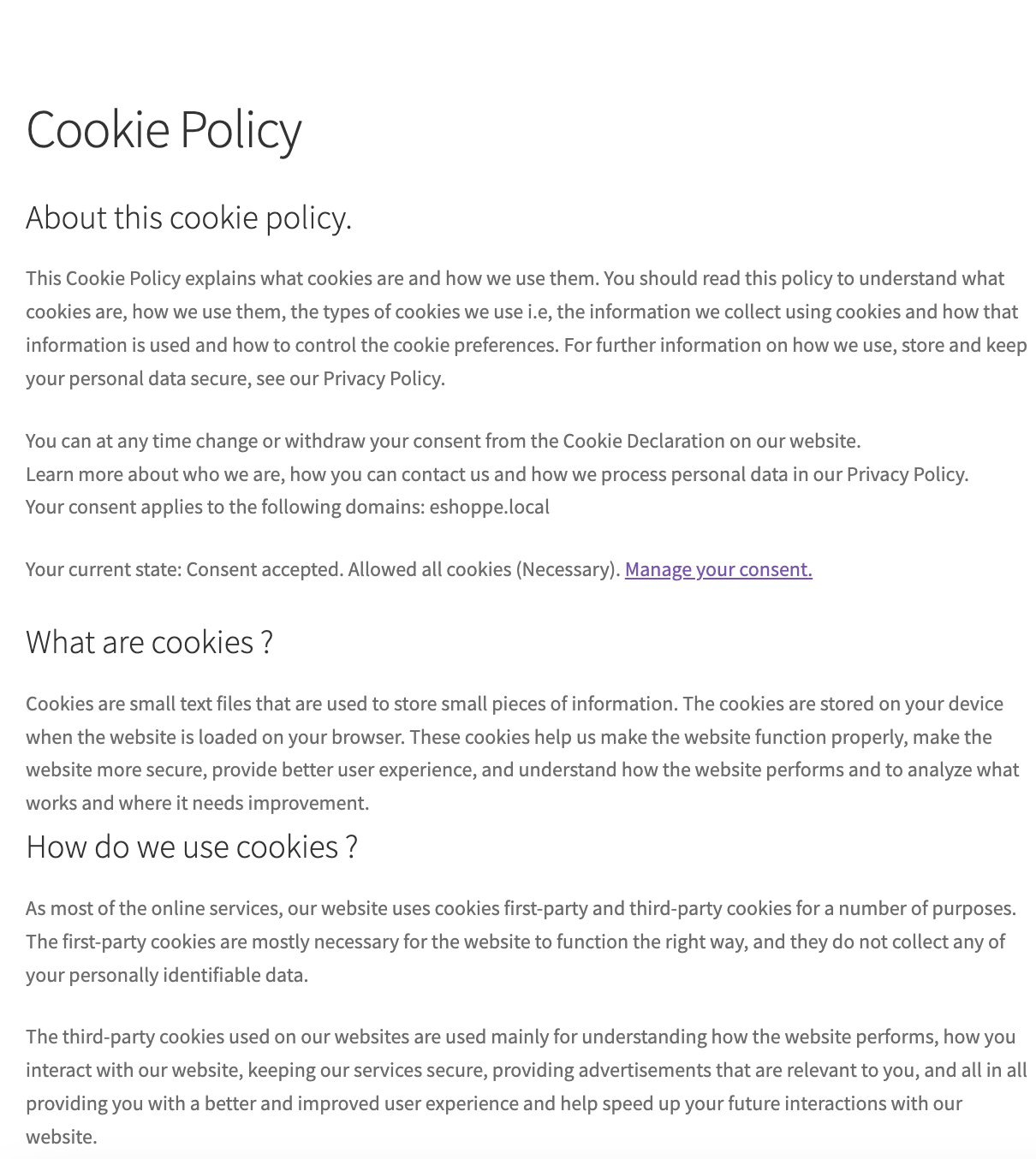
Next, copy and paste the cookie policy page URL into the cookie notice settings to display the link on the cookie notice.

Cookies that are essential for a website to function are exempt from GDPR consent requirements. These include cookies used for core functions such as security, page navigation, login sessions, and shopping cart operations. Even though consent is not required for these cookies, websites must still inform users about their use.
Yes, a cookie policy is required if your website uses cookies. The policy helps inform users about what cookies are used, why they are used, and how they can manage their preferences.
Removing all cookies is not recommended, as many cookies are essential for basic website functioning and user experience. Cookies help to keep users logged in, save preferences, and enable secure transactions.
If you have business in the EU region, you already know about the General Data Protection Regulation and EU Cookie law. As part of EU legislation, these laws are aimed to protect citizens’ privacy and give them more control over their personal information.
Privacy laws are one part of EU compliance, but if you run an online store, consumer protection rules apply as well. EU buyers can cancel online orders within 14 days, and you can support this right of withdrawal for WooCommerce orders with a free plugin that adds a withdrawal request button to your store.
As a website owner, GDPR requires you to inform your users about your website’s cookie usage. Your website needs to have a properly drafted cookie policy in order to adhere to GDPR guidelines.
Apart from complying with legal regulations, cookie policies also help you gain the trust of your users. People are more concerned about their privacy these days. Complying with major privacy laws like GDPR will indicate that you value their privacy.
Make these pages easily accessible from the home page of your website. You can also add a link to cookie preferences settings on your cookie policy allowing your site visitors to change their consent at any time.
Hopefully, this article has helped you in understanding the requirements for a GDPR-compliant cookie policy. If you have any doubts on your mind, feel free to drop them in the comments section below.