Share:


Table of Contents
Shopify SEO apps are essential tools that enhance the search engine optimization of online stores, addressing common pitfalls and automating tedious tasks. These applications cater to various needs, from automating fixes for technical issues to generating AI-driven content, ultimately improving visibility across search engines and AI platforms.
- Shopify's built-in SEO features provide a solid foundation, but gaps can arise as stores grow, necessitating specialized SEO apps.
- SEO apps can automate tasks like fixing broken links, optimizing meta tags, and generating alt text, saving time for store owners.
- Some apps focus on teaching users SEO principles while others prioritize automation, catering to different levels of expertise.
- The rise of AI search tools like ChatGPT and Gemini highlights the importance of monitoring and optimizing for these platforms alongside traditional search engines.
- Choosing the right SEO app depends on specific needs, such as structured data optimization, content generation, or general technical fixes.
- A successful SEO strategy combines the use of these tools with strong product pages, valuable content, and a seamless customer experience.
Shopify gives you a decent SEO starting point. Your sitemap and robots.txt are generated automatically, canonical tags are handled, and you can edit titles and meta descriptions for every product.
The gaps show up as you grow. Writing meta tags for 800 SKUs by hand isn’t realistic. Image alt text gets skipped. Discontinued products leave broken links behind. Your theme’s structured data may be missing fields Google wants for rich results. And now there’s a whole new layer to think about: whether ChatGPT, Perplexity, and Google’s AI answers mention your store at all.
That’s where SEO apps come in. Some fix issues automatically, some teach you to fix them yourself, and a few focus entirely on AI search visibility.
We went through the Shopify App Store and picked out the best SEO apps for Shopify across different needs, from simple tools for new stores to full platforms for large catalogs. Here’s what each one does well and who it suits.
1. BOOSTER AI SEO
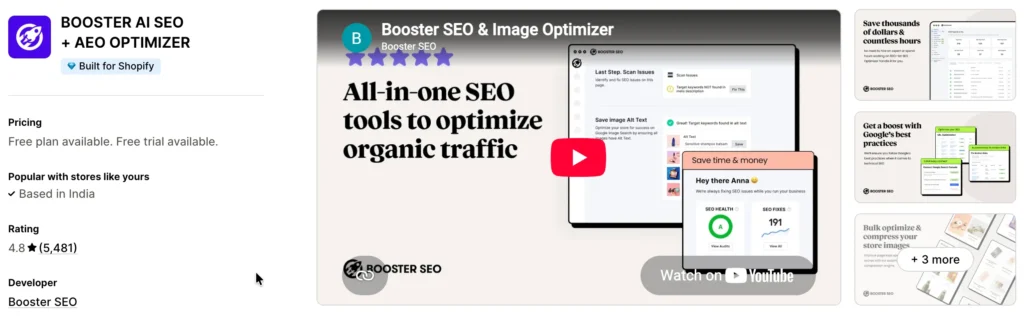
BOOSTER AI SEO is an automation-first app built for store owners who’d rather not touch SEO settings every week. It scans your store continuously and fixes common problems on its own, including missing alt text, broken links, oversized images, and weak meta tags.
It also prepares your store for AI search with an LLMs.txt file, structured data, and AI-optimized meta tags. Other features include automated sitemap submission to Google, URL keyword optimization, image filename optimization, and weekly email reports. It connects with Google Search Console and popular review apps like Judge.me, Loox, Okendo, and Yotpo.
With more than 5,400 reviews and a 4.8 rating, it’s one of the most widely used apps in the category. It’s a good fit if you want SEO running in the background with minimal hands-on work.
2. WinnSEO AI SEO
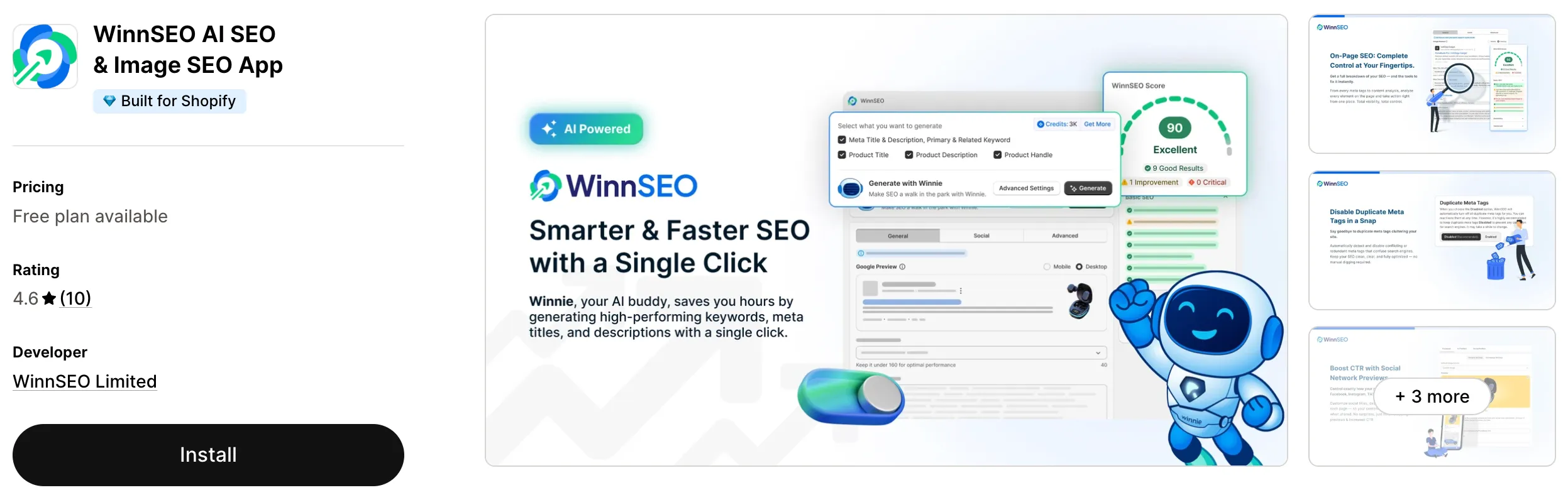
WinnSEO AI SEO is a newer app (launched in August 2025) that leans heavily on AI content generation. It can write SEO-friendly product descriptions and blog posts, bulk-generate image alt text, and rename image files in one go.
On the technical side, it lets you disable duplicate meta tags, edit robots.txt and LLMs.txt, set custom canonicals, customize social previews, and import or export all your SEO data. There’s also a competitor SEO analysis tool that shows how your pages stack up, plus an on-page editor with a live Google snippet preview.
WinnSEO suits stores that want to combine technical cleanup with AI-written content in one place, especially if product descriptions and blog content are the bigger bottleneck.
3. Plug in SEO
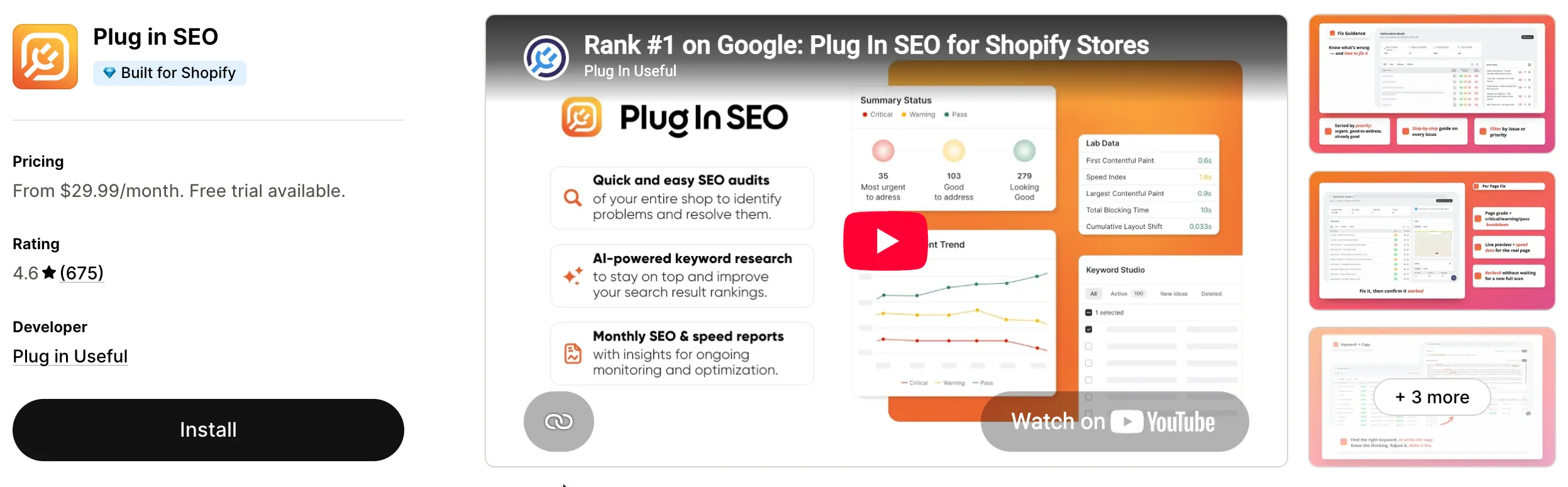
Plug in SEO has been on the Shopify App Store since 2011, which makes it one of the longest-running SEO apps on the platform. Its approach is a little different from automation-heavy tools. It diagnoses problems and walks you through fixing them, so you learn SEO along the way.
The SEO Scanner flags issues from missing tags to broken schema. Keyword Studio uses AI to research what shoppers are searching for, then writes titles and descriptions around those keywords. You approve every change before it goes live. It also handles schema markup, one-click broken link redirects, speed and performance reports, and AEO tools for AI search.
Higher plans include a call with an SEO expert, which is useful if you’re new to SEO and want someone to point you in the right direction.
4. MetaMaster
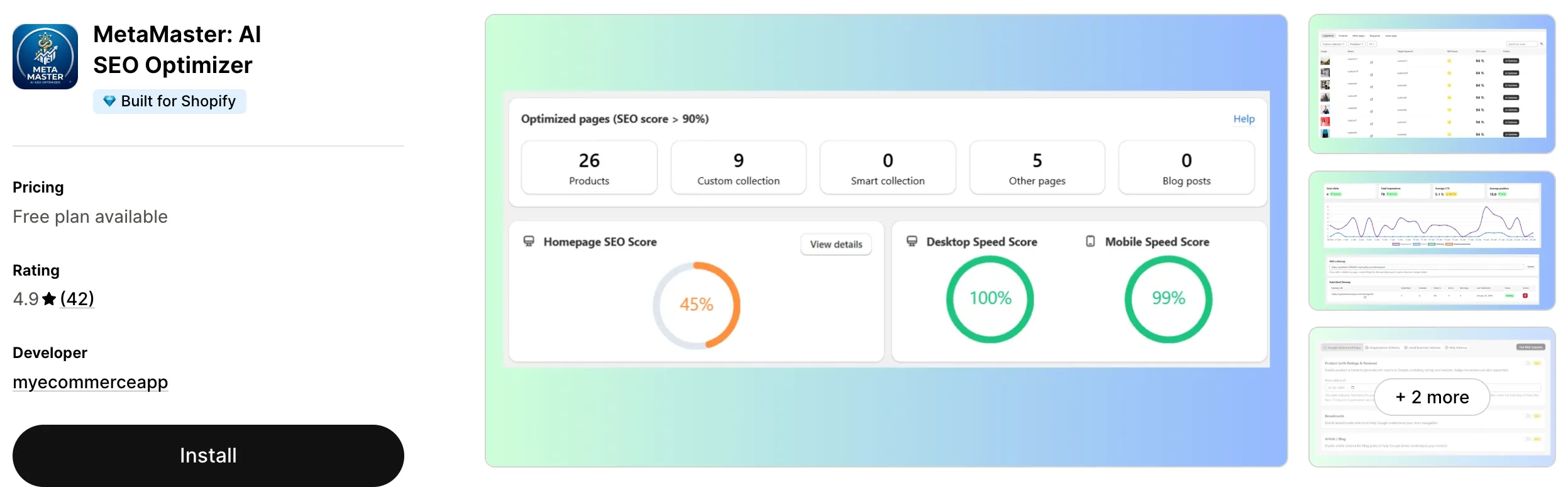
MetaMaster covers a lot of ground for a lightweight app. It finds SEO issues across products, collections, pages, and blogs, then generates AI titles, meta descriptions, product content, and an LLMs.txt file.
You also get broken link fixes, redirect management, image alt text optimization, and schema markup for Product, FAQ, Article, Breadcrumb, Organization, and Local Business types. Connecting Google Search Console and GA4 lets you see top pages, search queries, and analytics insights without leaving the app.
It’s a straightforward pick for smaller stores that want the essentials handled without a steep learning curve. Reviewers frequently mention how easy it is for beginners.
5. SEOLab
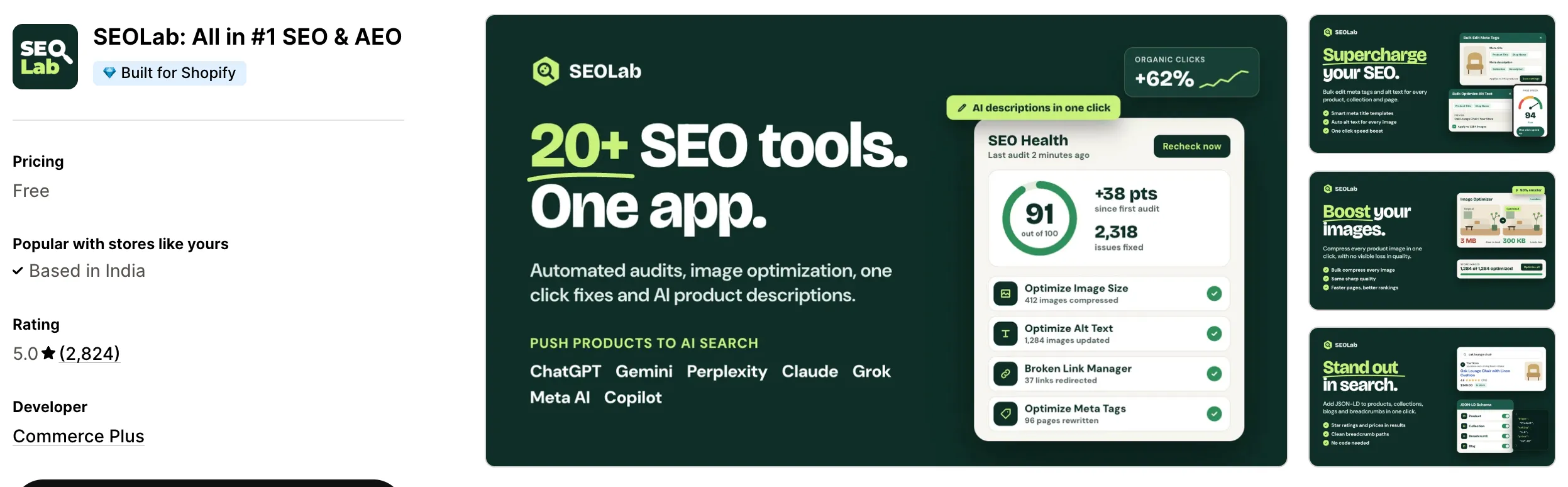
SEOLab positions itself as an all-in-one SEO toolkit for store owners who don’t want to deal with technical details. It covers LLMs.txt, JSON-LD structured data, site speed, image SEO, keyword research, backlinks, and indexing in one dashboard.
It auto-scans your store for indexing issues, speed problems, content quality, and tag errors, then helps you fix them. Broken links can be redirected in bulk, and the AI writer creates product descriptions. SEOLab also tracks your store’s visibility in ChatGPT, Gemini, and other AI tools, not just Google.
It holds a 4.9 rating from more than 2,700 reviews, and reviewers frequently mention its support team.
6. Yoast SEO
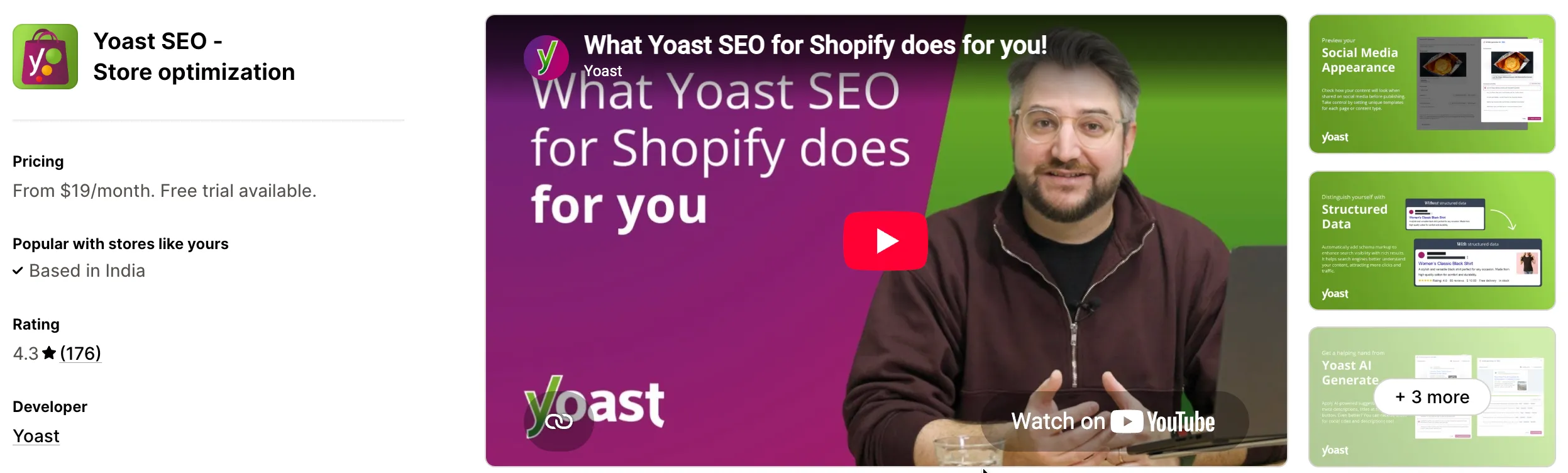
Yoast SEO will feel familiar if you’ve ever run a WordPress site. The Shopify version brings the same guidance-led approach, with SEO and readability analysis right inside your product editor, plus AI suggestions for titles and meta descriptions.
Structured data is added automatically to your products, and technical SEO tasks, including llms.txt generation, run without any coding. An overview page shows which products need the most attention, and the bulk editor supports import and export. It integrates with Semrush, Weglot, Langify, and several review apps.
The AI+ plan goes further with an AI Visibility Index, sentiment analysis, competitor benchmarking, and citation tracking to show how AI tools talk about your brand.
7. Kwik GEO
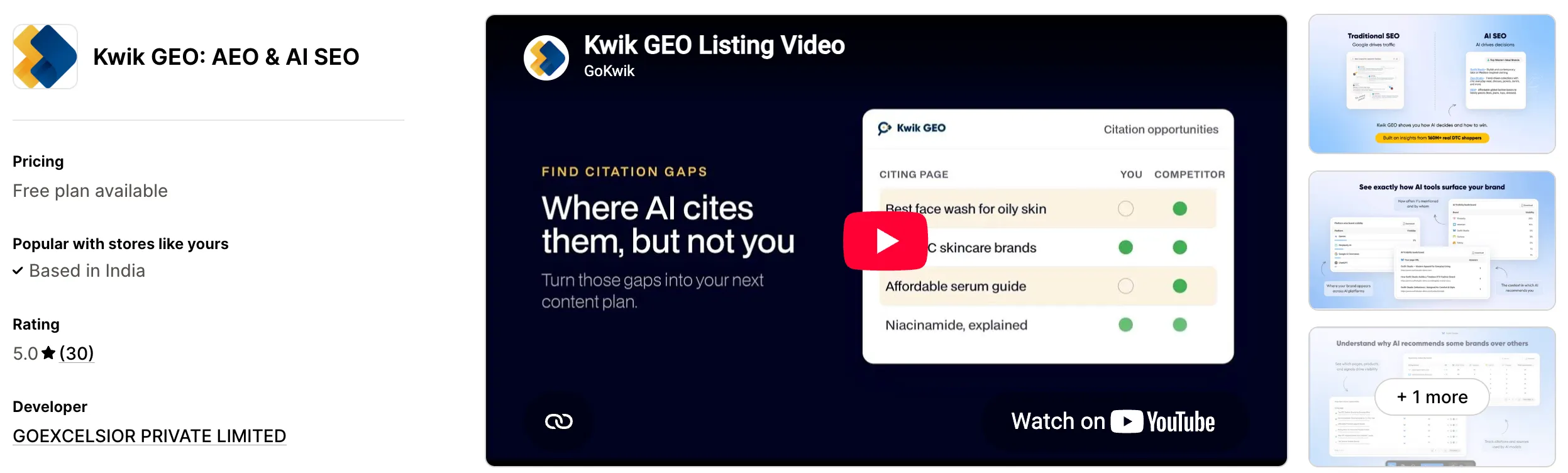
Kwik GEO isn’t a traditional on-page SEO app. It’s built for generative engine optimization (GEO), meaning it focuses on how AI tools recommend your brand rather than how Google ranks your pages.
The app tracks when ChatGPT, Perplexity, Gemini, and Google AI mention your store, compares your share of voice against competitors, and reads the sentiment behind those mentions. It also shows the prompts you’re missing from, the citation gaps on each platform, and the pages AI tools cite, so you know where to focus your content. It runs technical, on-page, entity, and blog audits too, and can generate and auto-publish AI blog posts.
Since it doesn’t handle everyday on-page fixes, Kwik GEO works best alongside one of the other apps on this list.
8. Avada AI SEO
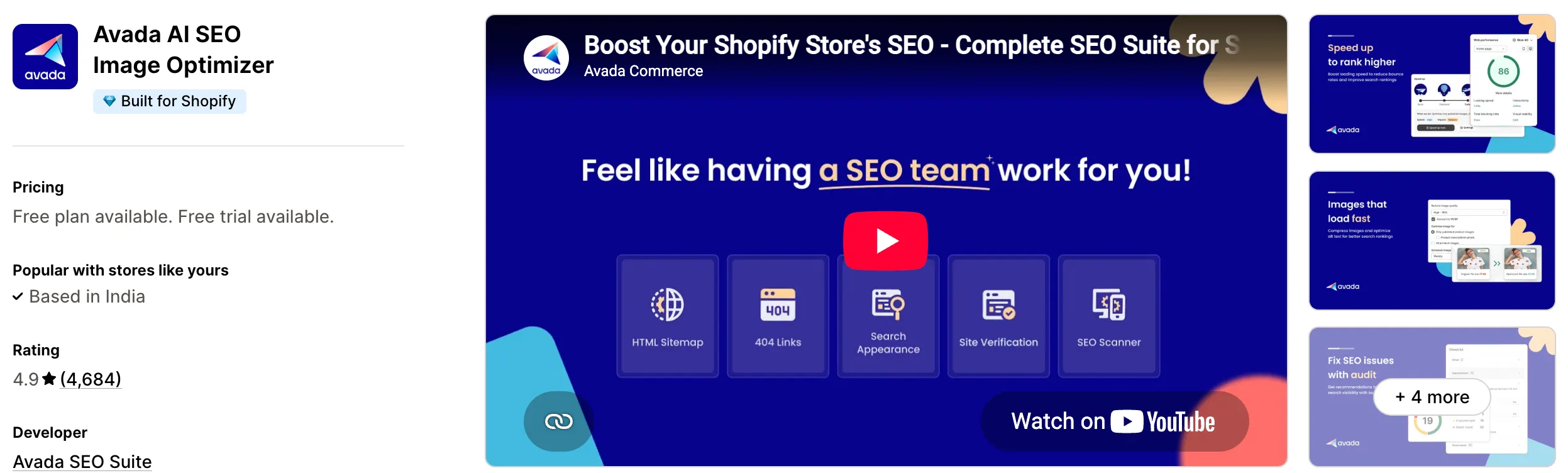
Avada AI SEO combines SEO and page speed in one app. Its AI SEO Audit Agent scans every page for issues, from meta tags to slow images, and applies AI-powered fixes in one click. A built-in SEO checklist walks you through each step so nothing gets missed.
The On-Page SEO Optimizer handles speed improvements like lazy loading and minification, plus technical SEO such as structured data, XML and HTML sitemaps, redirects, and a robots.txt editor. Image tools cover compression, resizing, and alt text. It also works with Shopify Flow if you want to automate SEO tasks.
It holds a 4.9 rating from more than 4,600 reviews, with many reviewers highlighting hands-on help from the support team on speed and technical fixes.
9. Webrex
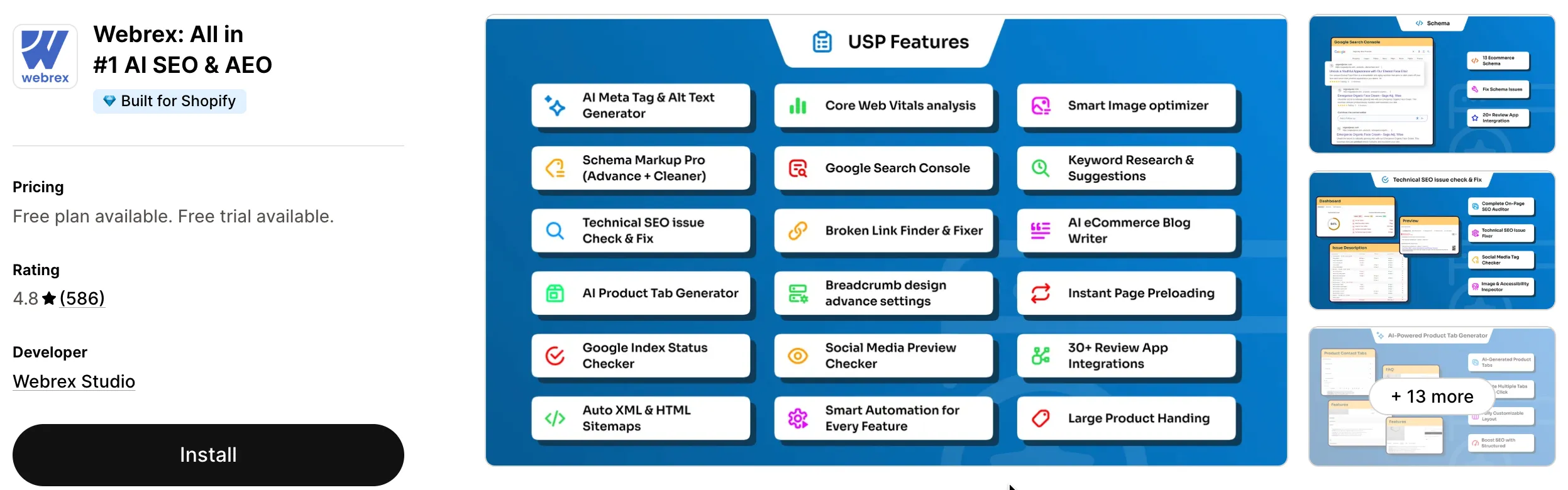
Webrex goes deepest on structured data, which makes it a strong fit for stores chasing rich results in Google. Its JSON-LD engine supports Product, FAQ, Video, Review, and Recipe schema, and it can remove duplicate or outdated schema that themes and old apps leave behind.
Beyond schema, Webrex runs 50+ technical SEO checks across meta tags, sitemaps, and 404s. It bulk-generates meta tags, descriptions, and alt text with AI, adds 5-level breadcrumbs, generates SEO-ready blog posts, and monitors Core Web Vitals. It also connects with Google Search Console and more than 30 review apps, including Judge.me, Loox, Okendo, Stamped, and Yotpo.
If rich snippets and clean schema are your priority, Webrex is worth a close look.
10. TinySEO
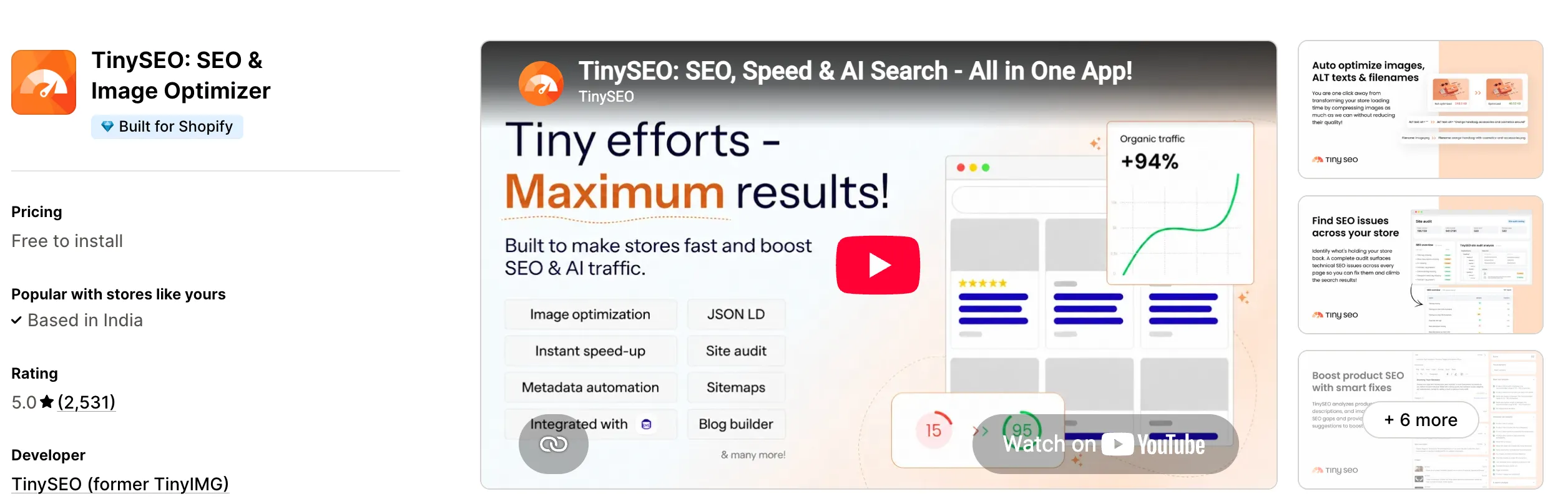
TinySEO started life as TinyIMG, an image optimizer, and has grown into a full SEO and page speed toolkit. Image optimization is still a core strength, covering compression, resizing, alt text, and SEO-friendly filenames.
On the SEO side, it finds and fixes issues, adds JSON-LD schema and LLMs.txt, redirects broken links with 301s, generates AI product titles and descriptions, and builds HTML sitemaps. It also supports IndexNow for faster indexing on Bing and Yandex, along with lazy loading and JS/CSS minification for speed. An AI blog builder and automated site audits round things out.
The best SEO app for your Shopify store depends on where you need the most help. If you want SEO tasks handled automatically, tools like BOOSTER AI SEO, Avada AI SEO, and TinySEO cover a broad range of optimization tasks with minimal manual work. For more guidance and control, Plug in SEO and Yoast SEO make it easier to understand what needs fixing and why.
Stores focused on structured data and rich results may get more value from Webrex, while Kwik GEO and the AI visibility features in tools like SEOLab are worth considering if visibility across ChatGPT, Perplexity, Gemini, and other AI platforms is becoming a priority.
Whichever app you choose, remember that an SEO tool can only support your strategy. Strong product pages, useful content, a technically sound store, and a good customer experience still do most of the heavy lifting. Start with the SEO problems that are holding your store back, choose an app that addresses them, and build from there.


Subcribe to our newsletter