


Share:


Table of Contents
Remittance advice is a crucial document that informs sellers about payments made by buyers, detailing the amount paid, payment date, and the invoices covered. It plays a significant role in financial record-keeping, facilitating accurate matching of payments to invoices and streamlining the reconciliation process for businesses.
- Remittance advice serves as a notification from the buyer to the seller that a payment has been made or is forthcoming.
- It typically includes payer and payee details, invoice numbers, amounts paid, payment date, and payment method.
- There are three main formats for remittance advice: paper, email, and electronic remittance advice (ERA).
- Unlike invoices, which request payment, and receipts, which confirm payment, remittance advice indicates which invoices a payment covers but does not serve as proof of payment.
- Sending remittance advice is not legally required but can enhance communication and clarity between buyers and sellers.
- Businesses should verify the details in remittance advice against their records and confirm receipt of funds before marking invoices as paid.
When a business makes a payment, it’s important for the recipient to know what the payment is for. This is where remittance advice comes in. It provides details about a payment, including the amount paid, payment date, and invoices covered.
Remittance advice helps businesses keep track of payments, match them with invoices, and maintain accurate financial records.
In this article, we’ll explain what remittance advice is, what it includes, the different types, and how it differs from an invoice or receipt.
Remittance advice is a document or message a buyer sends to a seller to confirm that a payment has been made or is on its way. It lists the invoice numbers the payment covers, the amount paid against each one, and the payment date and method.
The word “advice” here simply means notice. A remittance is money sent from one party to another, so remittance advice is a notice about money you’ve sent.
The payer, usually the buyer, sends it. The seller’s accounts receivable team uses it to match the money to the right invoices.
The practice started with paper checks. Buyers tore a slip off the bottom of an invoice and mailed it back with their payment. Today, most remittance advice arrives as an email or PDF attachment, or comes straight from accounting software.
Most retail orders never need remittance advice. A customer pays by card at checkout, and WooCommerce or Shopify ties that payment to the order automatically.
Remittance advice shows up when payment happens outside the checkout:
- B2B and wholesale orders on net terms: A trade buyer receives several invoices over a month, then settles them in one payment. Their remittance advice tells you which orders that payment covers.
- Bank transfer and check payments: WooCommerce’s built-in Direct bank transfer and Check payments methods hold orders until you confirm the money arrived. Remittance advice tells you what to look for.
- Paying your own suppliers: When you pay a manufacturer or dropshipping partner for multiple invoices, sending remittance advice spares both teams the back-and-forth over which invoice the payment was meant for.
Remittance Advice doesn’t have a fixed format, but useful remittance advice answers one question for the seller: which invoices does this payment settle?
Most include:
- Payer and payee details: Business names, addresses, and a contact person for payment questions.
- Invoice numbers: Every invoice the payment covers, listed individually.
- Amount paid per invoice: Plus the total, so partial payments are easy to spot.
- Deductions or credits: Early-payment discounts, returns, or credit notes applied.
- Payment date and method: Bank transfer, check, ACH, or card.
- Reference number: The transaction ID or check number that appears on the bank statement.
Invoice numbers do the heavy lifting here. If your invoices don’t carry a clear, unique number, buyers have nothing reliable to quote. Our PDF Invoices & Packing Slips for WooCommerce adds a numbered PDF invoice to every WooCommerce invoice email, giving trade customers a reference they can copy straight into their remittance advice.
Remittance advice comes in three main formats. The right one depends on how you get paid and what your buyer’s accounting system can send.
Paper Remittance Advice
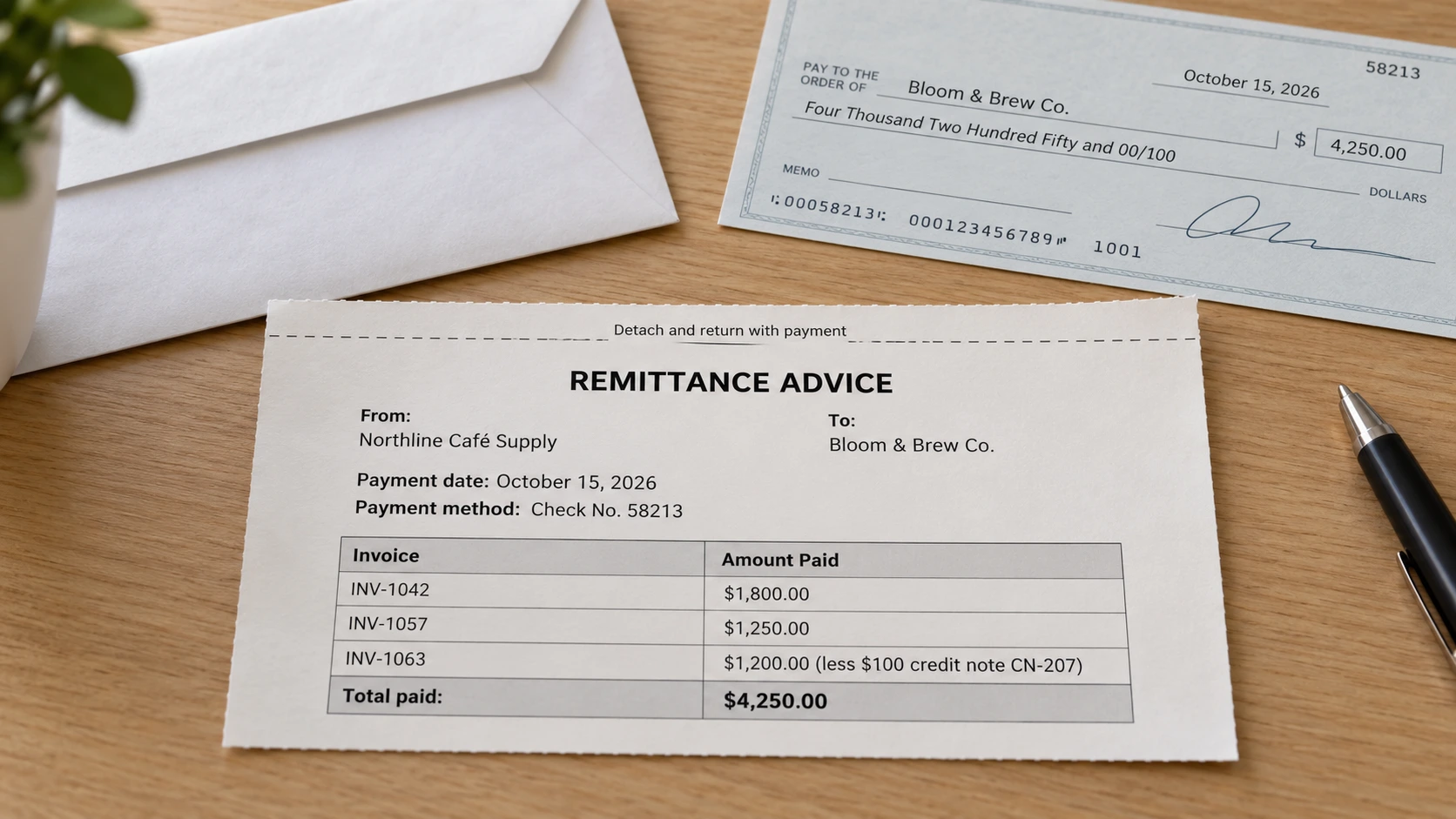
A printed slip mailed with a check, often the tear-off strip at the bottom of an invoice. You’ll mostly see it from older suppliers, local businesses, and buyers who still pay by check. It works, but someone has to key the details in by hand.
Email Remittance Advice
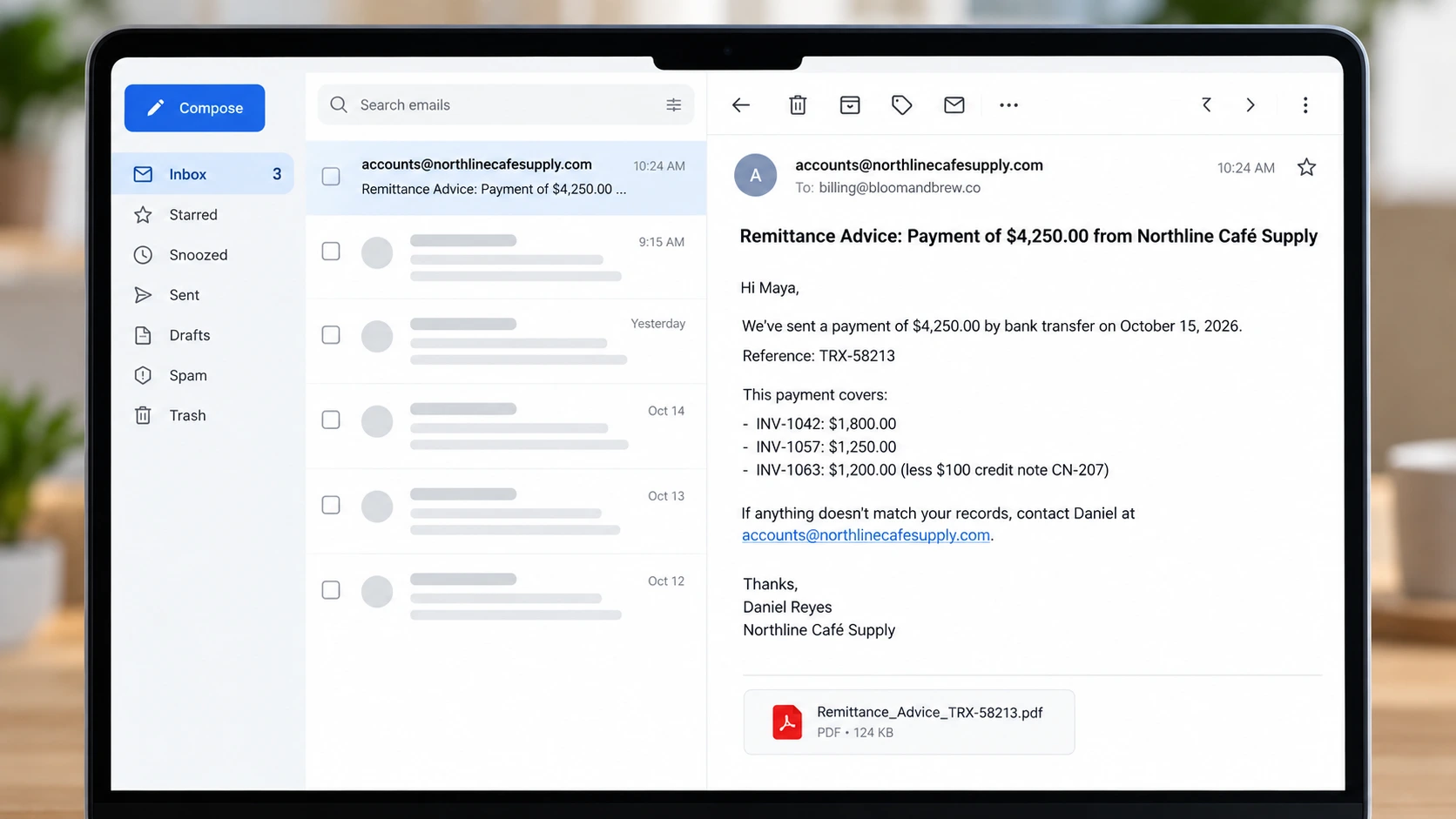
A short email or PDF attachment confirming which invoices a payment covers, like the template above. It’s the most common format for small B2B sellers and wholesale buyers paying by bank transfer. Many accounting tools send it automatically when a payment goes out.
Electronic Remittance Advice (ERA)
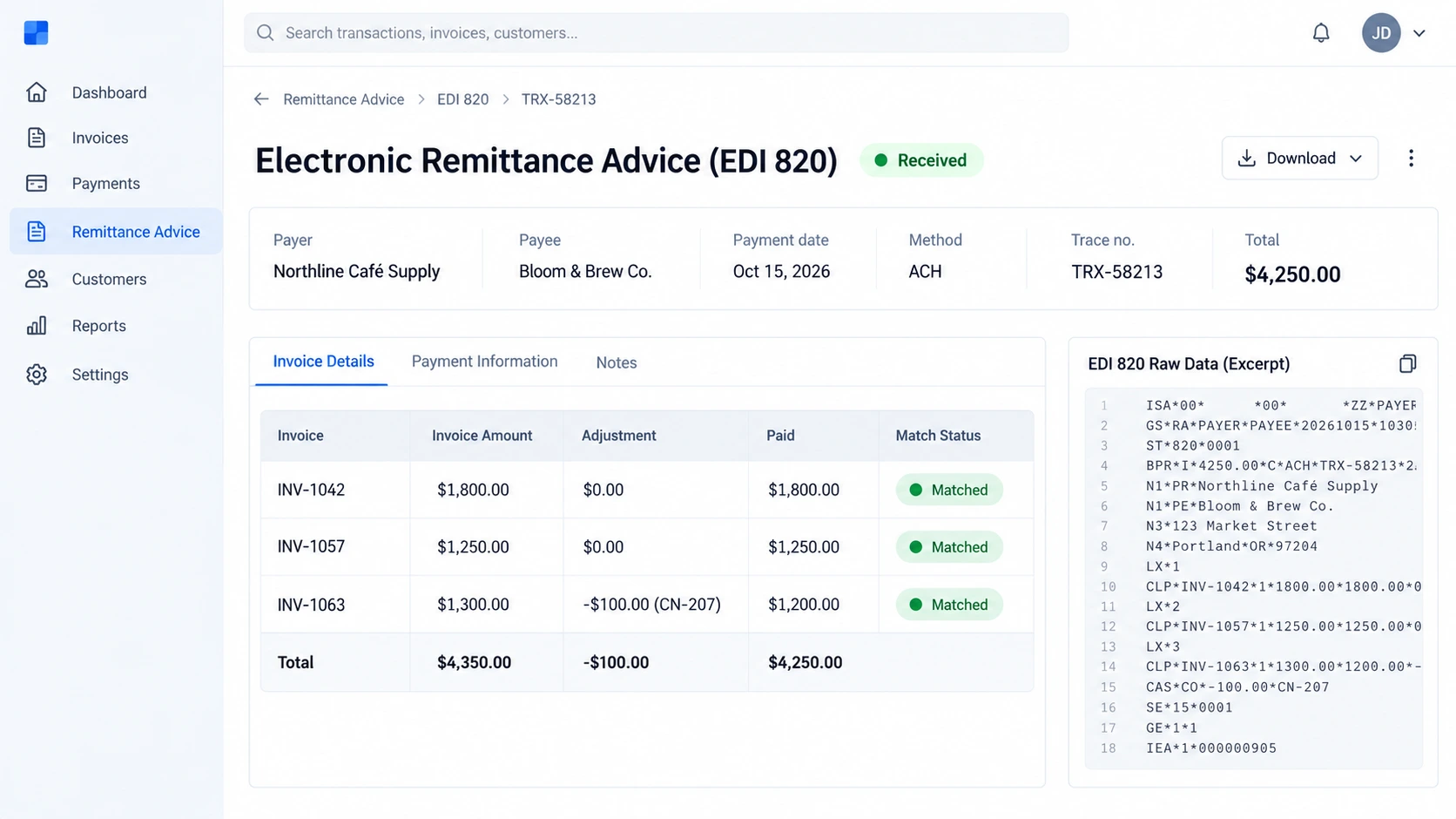
Structured data sent directly between business systems, usually through electronic data interchange (EDI), a standard format for exchanging business documents. Large retailers and distributors use it to pay suppliers at volume. In US healthcare, ERA refers specifically to insurance payment statements.
All three documents relate to the same sale, but each one does a different job.
Invoice
An invoice is the seller’s request for payment. It goes out after the sale or delivery and lists what the buyer owes, the due date, and how to pay. It doesn’t prove anything has been paid.
Remittance Advice
Remittance advice comes from the buyer when they pay. It tells the seller which invoices the payment covers and how much went toward each one. It’s useful for matching payments, but it isn’t proof of payment. A wrong account number or a bank delay can stop the money from landing, even after the buyer sends the advice.
Receipt
A receipt closes the loop. The seller issues it once the money arrives in their account, confirming the payment was received. That makes it the only one of the three that actually proves payment.
When remittance advice lands in your inbox, work through these four steps before you mark anything as paid.
- Match it to your invoices: Check each invoice number and amount against your records. Note any deductions, like credit notes or early-payment discounts, and confirm you agreed to them.
- Confirm the money arrived: Check your bank statement for the reference number. For WooCommerce orders paid by Direct bank transfer or check payments, change the status from On hold to Processing only after the funds clear.
- Follow up on short payments: If the amount doesn’t match what’s owed, contact the buyer right away and ask what the difference covers.
- Watch for fake remittance emails: Scammers often send fake “remittance advice” attachments to deliver malware or steal login details. Don’t open unexpected attachments or links, and verify with the sender through a contact you already have.
Is remittance advice required?
No. Remittance advice is a courtesy, not a legal requirement. The exception is when a supplier or wholesale buyer asks for it in their payment terms. In that case, sending it becomes part of the agreement.
Why did I get a remittance advice check?
Someone has paid you, and the remittance advice explains what the check covers. Insurers, government agencies, and business customers often send a check with a remittance stub attached listing the invoices, claims, or refunds included in the payment.
Can I cash a remittance advice check?
Yes, if it’s an actual check made out to you. Look closely first, though. A document marked “non-negotiable” or “this is not a check” is only a statement for a payment already deposited into your account, so there’s nothing to cash.
What is the value of a remittance advice?
It tells the seller exactly which invoices a payment settles and how much went toward each one. That makes reconciliation faster, flags partial payments early, and cuts down on emails asking which invoice a payment was meant for.
What is remittance advice in medical billing?
In medical billing, the insurer sends remittance advice to the healthcare provider. It explains what was paid on each claim, plus any adjustments or denials. The electronic version is called an electronic remittance advice (ERA), sent in the standard 835 format.
Remittance advice is a simple but useful document that helps businesses track payments and match them to the right invoices. It provides key payment details, reduces confusion, and simplifies payment reconciliation.
Whether it’s sent as a paper slip, email, or electronic document, remittance advice helps buyers and sellers maintain clear payment records.
While remittance advice is not proof of payment, it helps keep financial transactions organized and ensures accurate recordkeeping.


Subcribe to our newsletter


