



Share:


Table of Contents
Subscription-based business models are revolutionizing the way consumers access products and services, allowing for convenience, cost savings, and personalized experiences. This approach not only provides businesses with a steady revenue stream but also fosters long-term customer loyalty, making it a critical strategy in today’s competitive market.
- Subscription businesses create predictable revenue streams, enabling better financial planning for companies.
- They enhance customer retention by promoting ongoing relationships and reducing acquisition costs.
- Consumers benefit from convenience and cost savings through automated delivery and bundled services.
- Personalization in subscription offerings improves customer satisfaction by aligning products with individual preferences.
- Various subscription types exist, including boxes, streaming services, and SaaS, catering to diverse consumer interests.
- Current trends include hybrid models, sustainability initiatives, and the use of AI for personalized recommendations.
Most businesses spend everything acquiring customers and then start over the next month. Subscription businesses don’t work that way. You earn the customer once, deliver recurring value, and build a predictable revenue stream that compounds over time. That’s the model.
This guide covers 50+ subscription business ideas across every major category, including what makes each one work and how to get started.
What Makes a Subscription Business Model Work
Before jumping into ideas, it’s worth understanding why some subscription businesses thrive while others collapse within six months.
The difference almost always comes down to three things: recurring need, clear value, and low friction to stay subscribed.
- Recurring need means the customer genuinely wants or uses what you offer on an ongoing basis. Coffee, fitness coaching, software tools, and curated product boxes all satisfy a need that doesn’t go away. A one-time novelty gift doesn’t.
- Clear value means the subscriber always knows what they’re getting and why it’s worth paying for. Vague “access to exclusive content” memberships fail here constantly.
- Low friction to stay means renewing should feel like the default, not a decision. Automatic billing, consistent delivery, and real product quality all serve this.
Get these three right and churn stays manageable. Miss them, and no amount of marketing will save the business.
Types of Subscription Businesses (With Ideas Under Each)
1. Curated Subscription Boxes

The subscription box model works on the discovery principle: customers pay to be surprised and delighted with curated physical products they’d love but wouldn’t necessarily buy themselves.
This model suits physical products that are consumable, collectible, or experiential. The strongest boxes are deeply niched. For example, instead of simply saying “snacks,” say “Japanese import snacks” or “keto-friendly snack boxes from small-batch makers.”
Subscription box business ideas:
- Pet pamper packs: Monthly toys, treats, and grooming products matched to pet breed and size. The personalization angle is strong here. Brands like BarkBox have proven that the market is massive and retention is high when curation is good.
- Gourmet food boxes: Artisan cheeses, specialty hot sauces, single-origin chocolates, or regional foods from around the world. Food boxes work because the products are consumable and the discovery angle is genuine.
- Meal kit subscriptions: Pre-portioned ingredients with recipes for home cooking. HelloFresh and Blue Apron operate at scale, but there’s room in hyper-niche variants: Indian home cooking kits, 30-minute family dinners, or plant-based meal kits for specific dietary needs.
- Coffee subscription boxes: Rotating single-origin beans with tasting notes and brewing guides. Coffee drinkers are loyal and curious, which is a rare combination in any subscription audience.
- Beauty and skincare boxes: Curated samples and full-size products matched to skin type. Birchbox and BoxyCharm own the mass market, but clean beauty, K-beauty, and men’s grooming are underserved.
- Fitness and wellness boxes: Resistance bands, supplements, healthy snacks, and gear. Works well tied to a specific fitness style (CrossFit, yoga, running) rather than “fitness” broadly.
- Craft and hobby kits: Knitting, candle making, pottery, watercolor, or resin art kits with materials and instructions. ClayShare has built a real business around pottery specifically.
- Kids’ activity boxes: Age-targeted STEM kits, art projects, book clubs, or educational games. KiwiCo has dominated the mainstream, but niche variants by age band or learning style still have room.
- Book subscription boxes: Monthly curated reads in a specific genre or format, often with author notes and extras. Book of the Month and OwlCrate show the model works at scale; niche variants (indie fiction, literary fiction, graphic novels) are less crowded.
- Gardening and seed kits: Seasonal planting guides, seed packs, and care templates for indoor or outdoor gardeners. The plant parenting trend made this viable, and the niche is still early.
- Art supply boxes: High-quality supplies for artists at every skill level, sometimes tied to a monthly project or theme.
- Mystery boxes: Curated surprise product selections built around a theme. Fandom boxes (gaming, anime, specific TV shows) have a passionate audience.
- Sustainable product boxes: Eco-friendly personal care, cleaning products, or household goods from small-batch makers. Works well for the growing segment of shoppers actively replacing plastic-heavy products.
- Wine and beverage subscriptions: Monthly wine selections with tasting notes and food pairing suggestions. This model has licensing complexity by state/region, but the retention rates in wine subscriptions are among the highest in the box industry.
- Meat and seafood boxes: Locally sourced, ethically raised proteins delivered on a schedule. ButcherBox has built a nine-figure business on this model.
- Milk and dairy subscriptions: Fresh dairy delivered to the doorstep on a weekly or bi-weekly schedule. Common in urban India and growing in Western markets as farm-to-table demand rises.
2. Digital Content Subscriptions
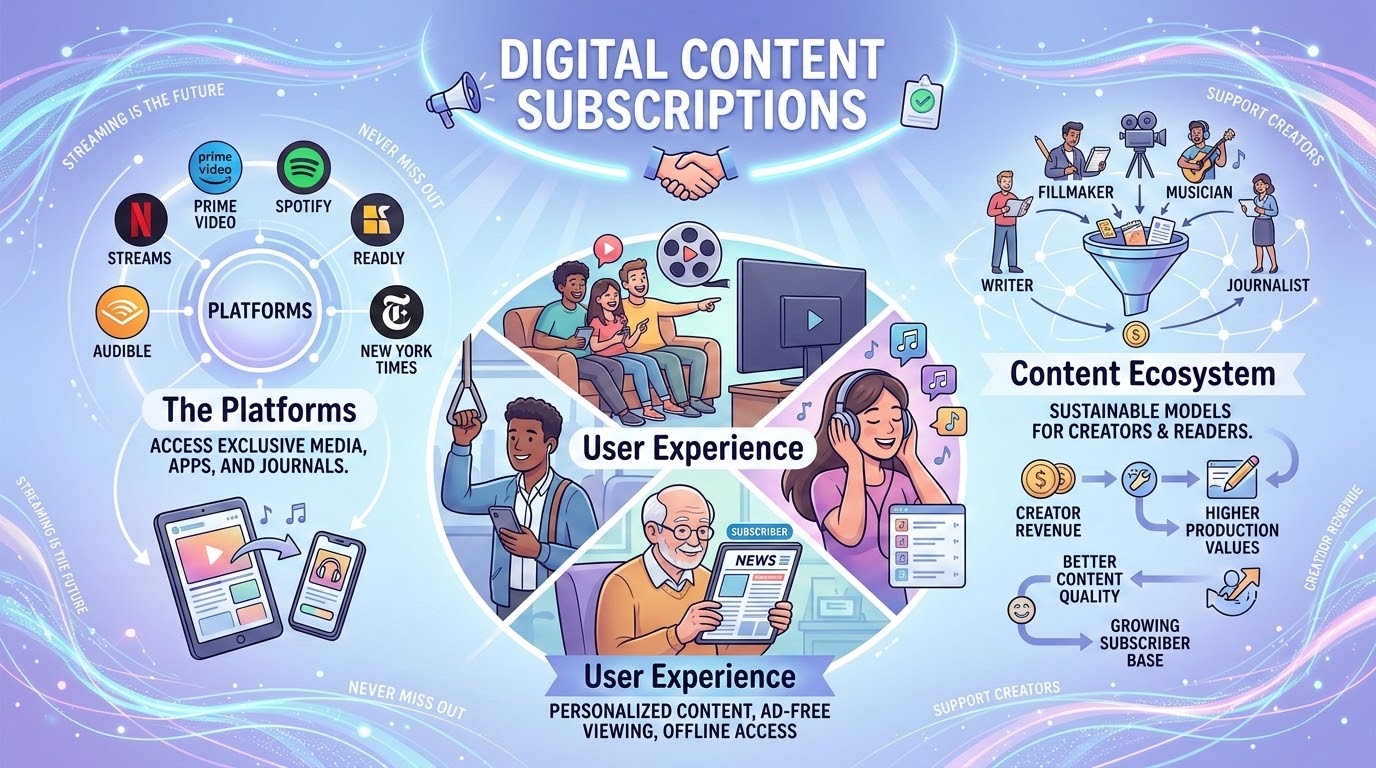
Digital subscription business ideas have one structural advantage over physical boxes: zero shipping costs and near-zero incremental delivery costs. Once the content exists, serving it to 10 subscribers or 10,000 costs almost the same.
The challenge is demonstrating enough ongoing value that subscribers don’t cancel the moment they’ve consumed everything in the first week.
Digital subscription business ideas:
- Paid newsletters: A focused weekly or monthly newsletter for a specific professional audience. Career advice, market research, niche industry news, or financial analysis.
- Digital resource libraries: Subscription access to a growing library of templates, fonts, stock photos, design assets, worksheets, or printables. Linguahouse charges $99/year for teachers to access lesson plan templates. The same model works for photographers, real estate agents, web developers, and dozens of other professions.
- Online course memberships: Ongoing access to a course library that grows each month. Works best in niches where the subject matter evolves (digital marketing, programming, legal compliance) rather than static skills.
- Membership communities: Paid access to a private forum, Slack group, or Discord community organized around a shared professional interest or hobby. The value is the people, not the content.
- Podcast subscriptions: Ad-free listening, bonus episodes, and early access for paying subscribers. Apple Podcasts and Spotify both support paid tiers for independent podcasters.
- Book clubs: Curated monthly reading selections with group discussions, author Q&As, and themed content. Can be physical (book shipped to the door) or fully digital (ebook + live discussion).
- E-book and audiobook access: Subscription access to a library of titles. Kindle Unlimited and Scribd own the mass market, but niche libraries (business books, academic texts, or genre-specific fiction) have an audience.
- Niche streaming platforms: A video subscription platform for a very specific interest. Classic car restoration, bird watching, competitive cooking, or regional dance styles. The Classic Car Restoration Club charges a monthly subscription for access to premium how-to videos. Mainstream platforms won’t niche down this far — that’s the gap.
- Digital comics and graphic novels: Subscription access to a curated library. ComiXology and Marvel Unlimited exist at scale, but independent comics and webcomics have a devoted niche.
- Fan club memberships: Exclusive content, behind-the-scenes access, and early releases for devoted fans of a band, artist, or creator. Patreon was built for exactly this.
- Virtual event access: Ongoing access to webinars, workshops, live Q&As, or virtual conferences on a specific topic.
- Niche newsletters with premium tiers: A free newsletter with a paid tier that unlocks deeper analysis, data reports, or access to a private community. The Hustle (now part of HubSpot) built this model to acquisition scale.
3. Software as a Service (SaaS)

SaaS is the most scalable subscription business model. Build once, sell infinitely. The catch is that building and maintaining software requires real technical investment, and competition in most categories is fierce.
The opportunity isn’t in building another project management tool. It’s in building narrow, purpose-specific tools for professional audiences that the major platforms don’t serve well.
SaaS subscription business ideas:
- Project management tools: Asana, Jira, and Monday own the general market, but niche variants for specific industries (construction scheduling, film production management, legal case tracking) still have unmet demand.
- CRM software: Salesforce and HubSpot dominate enterprise; there’s a gap for lightweight, industry-specific CRM tools for plumbers, real estate agents, freelancers, or personal trainers.
- Marketing automation platforms: Email sequences, popup automations, and behavioral triggers. WebToffee Ecommerce Marketing Automation app falls squarely here, targeting WooCommerce store owners who need cart recovery, email workflows, and popup campaigns without enterprise pricing.
- Accounting and invoicing tools: QuickBooks and Xero own the broad market. Niche variants for specific professions (freelance designers, food trucks, rental property owners) have less competition.
- HR and payroll software: Tools built for specific business sizes or industries. A 5-person restaurant doesn’t need the same HR software as a 500-person law firm.
- Cybersecurity tools: Antivirus, threat monitoring, and password management. The SMB market is underserved relative to the enterprise.
- Customer support tools: Help desk software, live chat, and support ticketing. Zendesk and Intercom dominate enterprise; lighter tools for small teams are an active market.
- eCommerce platform subscriptions: Shopify, WooCommerce, and BigCommerce are platforms, but the plugin and app ecosystem is subscription-based. WooCommerce plugins like Smart Coupons for WooCommerce, gift card tools, and product recommendation engines all follow a subscription billing model.
- Data analytics tools: Business intelligence, reporting dashboards, and visualization tools. The opportunity is in pre-built dashboards for specific industries rather than general-purpose analytics.
- Learning management systems (LMS): Platforms to host and sell online courses. Teachable and Kajabi own the mass market, but white-label LMS tools for corporate training or regulated industries have room.
- Scheduling and booking tools: Appointment management for salons, fitness studios, health practitioners, and freelancers.
- Legal compliance tools: GDPR compliance, cookie consent management, and data processing documentation.
- Client management tools for freelancers: Lightweight CRM, invoicing, and project tracking bundled for solo operators.
- AI-powered writing and content tools: AI assistants for specific content types (legal documents, marketing copy, technical documentation).
- Inventory management software: Purpose-built for specific retail types (restaurant inventory, retail store POS, warehouse management).
4. Membership Business Ideas

Membership businesses are distinct from content subscriptions in one key way: the value comes from access and community, not just from the content itself. Members pay to be part of something, not just to receive something.
Membership business ideas:
- Professional association memberships: Industry-specific communities with networking events, legal resources, and certification programs. Bar associations, medical societies, and trade organizations have run this model for decades; digital-native variants are cheaper to build and scale faster.
- Fitness and wellness memberships: Ongoing coaching, live classes, and community support for a specific training style. Leah Jantzen’s The Scrappy Athlete is a good example: a mental performance coach who turned 1:1 coaching into a scalable membership with ongoing content and community.
- Mastermind groups: Small-group peer advisory communities for founders, marketers, or professionals in a specific stage or industry. High price, high value, high retention.
- Online learning communities: Paid communities where members can ask questions, share work, and get feedback. The difference from a course membership is that the ongoing peer interaction is the product.
- Local service memberships: Monthly subscriptions to local services like lawn care, house cleaning, car washing, or meal delivery. The subscription model converts one-time service relationships into predictable recurring revenue.
- Coaching and consulting retainers: Freelancers and consultants who package their services as monthly retainers rather than per-project fees. The client gets consistent access; the provider gets predictable income.
- Hobby and interest communities: Paid communities for specific hobbies: sourdough baking (The Perfect Loaf Community charges $50/year and accounts for 25% of the creator’s income), knitting, woodworking, amateur astronomy, or niche gaming.
- B2B networking communities: Paid access to a curated network of professionals in a specific industry. Aleia Walker’s The Speakeasy Bar (a marketing community with monthly virtual happy hours) is a clean example.
- Dance and performing arts memberships: Video-based dance studios with subscription access to choreography tutorials, technique classes, and live sessions. The Cutting Edge Dance Studio offers tiered membership plans this way.
- Religious and spiritual communities: Paid membership for ongoing spiritual content, guided practices, and community access.
5. Monthly Subscription Business Ideas for Services

Service subscriptions convert what would otherwise be one-time or irregular purchases into a predictable relationship. The key is identifying services with a genuine recurring need and structuring them so that renewing is easier than canceling.
Monthly subscription business ideas in services:
- Car wash subscriptions: Monthly unlimited washes for a flat fee. Most major car wash chains now operate this model. For independent operators, it’s a way to compete with the chains.
- Home cleaning subscriptions: Bi-weekly or monthly deep cleaning on a fixed schedule. The customer stops thinking about it; you show up.
- Lawn and garden maintenance: Weekly or fortnightly service bundled into a monthly fee. Seasonal upsells (leaf clearing, fertilization, holiday lighting) layer on top.
- Babysitting and childcare subscriptions: A set number of hours per month with a trusted provider. Subscription pricing builds the ongoing relationship that ad-hoc childcare can’t.
- Pet sitting and dog walking: Monthly packages for daily walks or boarding during travel. High-retention service because pet owners’ needs don’t go away.
- Personal chef or meal prep: A chef who preps weekly meals on a subscription basis. Premium pricing, niche audience, high perceived value.
- Beauty treatment subscriptions: Monthly packages for haircuts, waxing, threading, or nail services. Salons can convert their most loyal customers into predictable revenue this way.
- Chauffeur or transportation subscriptions: Monthly ride credits for regular commuters or professionals who need reliable transportation.
- IT support subscriptions for small businesses: Managed IT services on a monthly retainer. Most small businesses need IT support occasionally, but can’t justify a full-time hire.
- Virtual assistant retainers: A set number of hours per month with a dedicated VA. Popular with founders and executives.
How to Choose the Right Subscription Business Niche
Choosing a niche isn’t about finding the biggest market. It’s about finding a specific audience with a recurring need that you can serve better than the generic options.
Here’s a practical way to evaluate any subscription idea before committing to it:
- Is there a recurring need? Ask whether your target customer genuinely needs or wants your product or service on an ongoing basis. Not “would they buy it once” but “would they miss it if it stopped?”
- Can you personalize it? Personalization is the strongest retention mechanism in any subscription business. Boxes that learn subscriber preferences improve over time. SaaS tools that track usage patterns offer more relevant features. Memberships that remember what members care about feel more valuable month after month.
- Is the niche narrow enough? “Fitness subscription” is not a niche. “Mental performance coaching for competitive athletes” is. The narrower the niche, the easier it is to market, the lower the customer acquisition cost, and the more passionate the audience.
- What does churn look like at scale? Some subscription categories have structurally higher churn. Novelty boxes (mystery boxes, seasonal gift subscriptions) have high initial conversion but low retention after month 3. Service subscriptions and SaaS tools with real workflow integration have much lower churn. Know your category before you build.
- Can you price it sustainably? Work backward from your desired gross margin. Include product cost, packaging, shipping (for physical boxes), platform fees, customer acquisition cost, and operational overhead. If the math doesn’t work at the price your audience will pay, the business doesn’t work.
Subscription Business Models: Pricing Structures That Work
Regardless of what you’re selling, the pricing structure determines how well your subscription converts and retains customers.
- Flat-rate monthly billing is the simplest model. One price, one set of benefits. Works well when the value is clear and consistent. Netflix, Spotify, and most SaaS tools use flat-rate pricing.
- Tiered pricing gives customers options: basic, standard, and premium. Each tier offers more access, features, or frequency. Works well when different customer segments have genuinely different needs and budgets.
- Usage-based billing charges based on consumption. Common in SaaS (API calls, seats, storage). Lowers the barrier to start, but makes revenue harder to predict.
- Freemium to paid offers core functionality for free and charges for advanced features. Effective for SaaS and digital tools because it lets customers experience the product before committing. The risk is that free users never convert.
- Annual vs. monthly options both matter. Annual plans reduce churn and improve cash flow. Monthly plans lower the barrier to signing up. Offering both at a discount for annual (typically 15-20% off) is standard practice.
Conclusion
If you’re selling subscription products or memberships through a WordPress store, WooCommerce has the infrastructure to support it. The core platform handles products and checkout; a WooCommerce subscriptions plugin handles the recurring billing logic, failed payment recovery, and subscriber management.
The subscription plugin will handle the operational layer: charging cards automatically on renewal, pausing or canceling subscriptions at the subscriber’s request, sending renewal reminder emails, and managing failed payment retries (dunning).
Beyond billing, the tools that drive subscription retention in WooCommerce stores tend to be the same ones that drive conversion in any eCommerce context:
- Product recommendations that surface relevant add-ons and upgrades
- Coupons and discount logic for subscriber-exclusive pricing
- Email automation for onboarding sequences, renewal reminders, and win-back campaigns
- Gift card plugins let subscribers gift their membership to others
If your subscription business runs on WooCommerce, those layers are worth getting right before scaling acquisition. Recovering 5% more churned subscribers is almost always cheaper than acquiring 5% more new ones.


Subcribe to our newsletter


