



Share:


Table of Contents
Affiliate marketing is a performance-based income model where individuals earn commissions by promoting products from other companies. It is crucial for beginners to understand that success in affiliate marketing relies on implementing a systematic approach rather than merely relying on follower counts or initial investments. Mastering this model is essential as it offers a scalable way to generate income online with minimal upfront costs.
- Affiliate marketing involves four key players: the merchant, the affiliate, the customer, and optionally, an affiliate network.
- The effectiveness of affiliate marketing is significantly influenced by the type of marketing adopted: unattached, related, or involved.
- Selecting a profitable niche is vital; it should have demand, available products, and manageable competition.
- Content creation must focus on high-intent topics that convert, such as product reviews, comparisons, and tutorials.
- Proper management of affiliate links and compliance with FTC guidelines are essential for building trust and ensuring transparency with the audience.
- Tracking performance metrics regularly helps identify successful strategies and areas needing improvement, leading to sustainable income growth.
Most people who try affiliate marketing quit before it works. Not because the model is broken, but because they go in without a system and mistake slow early results for failure.
The model itself is simple: you recommend products, people buy through your link, you earn a commission. No inventory, no customer service, no upfront ad spend required. What makes it hard is building the content, audience, and trust that turns clicks into consistent income, and that takes longer than most guides admit.
In 2025, the global affiliate marketing industry was worth around $20 billion. By 2034, it’s projected to hit $72 billion. Brands report an average return of $12 to $15 for every dollar spent on affiliate partnerships. The opportunity is real, but it rewards people who treat it like a business, not a side hustle they’ll figure out as they go.
This guide covers everything from the ground up: how affiliate marketing actually works, how to pick a niche and platform, how to find programs worth joining, what content formats convert, and how to track what’s working. There’s also a section specifically for WooCommerce store owners who want to run their own affiliate program, not just promote someone else’s.
Affiliate marketing is a performance-based model where you earn a commission for promoting someone else’s product. You don’t create the product, handle inventory, or deal with customer service. Your job is to drive traffic to the merchant’s product page through a unique tracking link. When someone buys through that link, you get a cut of the sale.
That’s the core of it. Everything else is execution.
Four players are involved in a typical affiliate marketing setup:
- The merchant is the brand or business selling the product. Amazon, Shopify, Bluehost, or any company with an affiliate program qualifies.
- The affiliate (that’s you) promotes the product through content, a blog post, a YouTube video, a social media post, or an email. The goal is to get the right people to click your link.
- The customer is the person who clicks your link and makes a purchase. They usually don’t know or care that an affiliate was involved. The price they pay is the same either way.
- The affiliate network is an optional middleman that connects merchants and affiliates on a single platform. Networks like ShareASale, impact.com, and Awin host hundreds of programs in one place, so you don’t have to track down individual merchants. Some merchants run their own in-house programs instead.
How the tracking works
When someone clicks your affiliate link, a cookie is stored in their browser. That cookie tells the merchant’s system that you referred that visitor. If they buy within the cookie window, you earn the commission.
Cookie windows vary significantly by program. Amazon Associates runs a 24-hour cookie; if the visitor doesn’t buy within a day, you get nothing. Other programs offer 30, 60, or even 90-day windows, which gives you a much longer earning window for the same click.
For example, you write a review of a project management tool that offers a 60-day cookie. Someone reads it, clicks your link, thinks about it for two weeks, then buys. You still earn the commission because the cookie was still active when they purchased.
That’s why cookie duration is one of the first things worth checking before joining any affiliate program.
Not all affiliate marketing works the same way. The difference comes down to how closely connected you are to the products you promote, and that connection directly affects how much your audience trusts your recommendations.
There are three types.

1. Unattached affiliate marketing
You have no personal connection to the niche or the product. You’re not a fitness person promoting gym equipment. You’re just running paid ads or placing links to drive traffic, often across multiple unrelated niches at once.
It’s the most hands-off approach, and it can work, but it requires ad spend, constant testing, and a solid understanding of paid traffic. For most beginners, it’s an expensive way to learn what doesn’t convert.
2. Related affiliate marketing
Here, you promote products that fit your niche, even if you haven’t personally used them. A tech blogger reviewing a laptop based on its specs. A food blogger recommending a kitchen gadget they’ve researched but not owned.
This works when your audience trusts your expertise in the space, even if not your direct experience with every product. It’s a reasonable middle ground for content creators who have built an audience around a topic.
3. Involved affiliate marketing
You use the product, believe in it, and recommend it because you’d tell a friend about it anyway. A WordPress developer who genuinely relies on a plugin and writes about it. A photographer who uses a specific editing tool daily and reviews it in depth.
This is the hardest type to fake, and the most valuable for that exact reason. Readers can tell the difference between someone who’s tested something and someone who’s summarizing a spec sheet. Conversion rates are higher, trust compounds over time, and you’re far less exposed when a product changes or underdelivers.
For beginners building a long-term affiliate income, involved affiliate marketing is the only one that scales sustainably. Unattached works at volume with ad budgets. Related works with an established audience. Involved works with genuine experience, which is something you can start building from day one.
| Type | Best for | Requires |
| Unattached | Paid ad campaigns | Ad budget, traffic expertise |
| Related | Content creators with niche authority | Audience trust, topic knowledge |
| Involved | Bloggers, reviewers, creators | Personal product experience |
A niche is the specific topic area your content lives in. It determines what products you’ll promote, what keywords you’ll target, and who your audience is. Get this wrong and no amount of good content fixes it. Get it right and you have a compounding asset that gets easier to grow over time.
Most beginners pick too broad or too personal. “Health” is not a niche. “Me and my wellness journey” is not a niche either, at least not one with predictable affiliate demand. The goal is a specific topic with three things working in its favor: people are actively searching for it, products exist that solve problems within it, and affiliate programs are available for those products.
The three-filter test
Before committing to a niche, run it through these three filters.
- Search demand: Are people actively looking for information in this space? Use Google Trends or Ahrefs to check whether interest in your topic is stable, growing, or declining. A niche with flat or rising search volume is worth pursuing. One that’s been declining for three years is a harder climb.
- Product availability: Do products exist that solve real problems in this niche, and do those products have affiliate programs? A niche with passionate readers but no monetizable products is a dead end. Check Amazon, ShareASale, or impact.com to see what programs exist before you commit.
- Competition you can actually compete with: High competition isn’t automatically bad; it confirms there’s money in the space. The question is whether you can carve out a corner of it. A beginner going after “personal finance” broadly is fighting Investopedia and NerdWallet. A beginner going after “budgeting tools for freelancers” has a real shot.
Go narrower than you think you need to
The sub-niche principle holds up consistently. “Photography” is too broad. “Wedding photography gear” is specific enough to attract a defined audience with clear buying intent. “Home office equipment” beats “gadgets.” “WooCommerce plugins for subscription businesses” beats “WordPress tools.”
Narrow niches feel limiting at first. In practice they’re easier to rank in, easier to build authority in, and easier to monetize because the audience’s needs are specific and the products that serve them are obvious.
Niches with consistently strong affiliate demand
Some topic areas generate reliable affiliate income because the products have real price points, strong programs, and audiences that buy. Personal finance, software and SaaS tools, health and fitness, home office and productivity, and WordPress and WooCommerce tools all fall into this category. The WordPress and WooCommerce space in particular is underestimated, the audience is technical, the products are high-value, and the affiliate programs (including many plugin companies) pay competitive commissions.
The niche you pick doesn’t have to be your deepest passion. It does have to be something you can write about with genuine depth for the next two years, because that’s the actual time horizon for building meaningful affiliate income.
Knowing what affiliate marketing is and actually building a system that earns is two different things. This section covers the full process from scratch: the exact steps, in order, with nothing skipped.
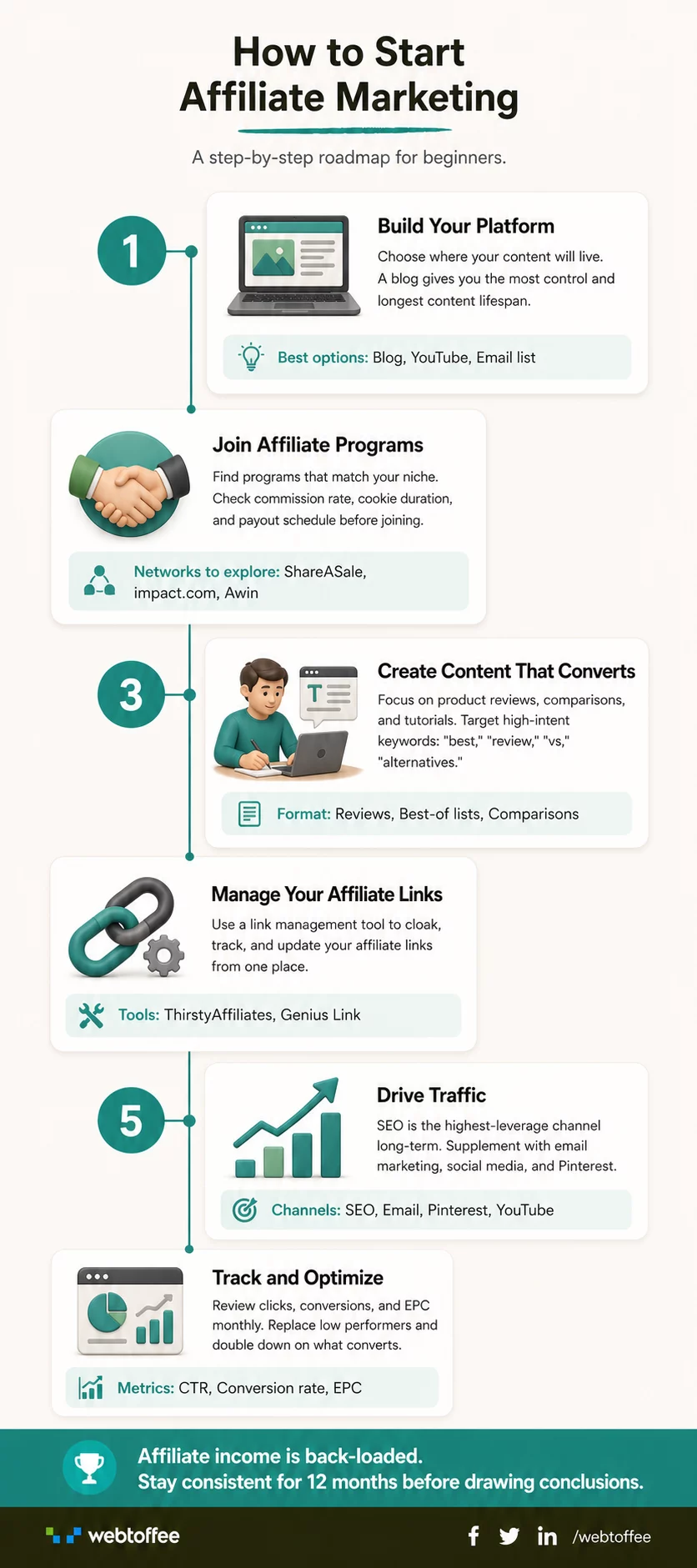
Step 1: Build your platform before you look for programs
The single biggest mistake beginners make is joining affiliate programs before they have anywhere to send traffic. A platform is where your content lives and where your audience comes to. Without one, your affiliate links go nowhere.
Your platform options:
- Blog or website is the strongest long-term choice. Content you publish today can rank on Google and generate clicks two years from now. You own it, you control it, and it compounds. For affiliate marketing built on SEO, a blog is the foundation.
- YouTube works well for product reviews, tutorials, and comparisons. Video builds trust faster than text in many niches. The downside is that production takes more time, and the algorithm can shift on you.
- Social media (Instagram, TikTok, Pinterest) works for lifestyle niches and product discovery. Pinterest in particular drives long-tail traffic that converts well for home, fashion, and recipe niches. The limitation is that social content has a short lifespan, and you’re building on someone else’s platform.
- Email list is the most underrated starting point. Even 500 engaged subscribers will outperform 10,000 passive social followers for affiliate conversions. If you’re building a blog or YouTube channel, start collecting emails from day one.
Pick one primary platform and build it properly before spreading to others. Trying to maintain a blog, a YouTube channel, and three social accounts simultaneously as a beginner is how you end up with mediocre content everywhere and traction nowhere.
Also Read: A Beginner’s Guide to WooCommerce SEO
Step 2: Find and join the right affiliate programs
Once you have a platform and content direction, it’s time to find programs that match your niche. There are two routes: direct programs and affiliate networks.
Direct programs are run in-house by the merchant. You apply on their website, get approved, and receive your unique tracking links. Amazon Associates is the most well-known example. Shopify, Bluehost, and most SaaS companies run their own programs. Direct programs often pay higher commissions because there’s no network taking a cut.
Affiliate networks are platforms that host multiple merchants in one place. Instead of applying to 20 programs individually, you create one account and apply to merchants within the network. The major ones worth knowing:
- ShareASale: Large network, reliable tracking, strong in retail and software
- impact.com: Growing fast, used by many SaaS and eCommerce brands
- Awin: Strong in Europe, good for international audiences
- PartnerStack: Focused specifically on SaaS products, often higher commissions
- CJ Affiliate: One of the oldest networks, broad merchant selection
- Rakuten Advertising: Solid for retail and consumer brands
What to check before joining any program
Commission rate and cookie duration are the obvious ones, but don’t stop there. Check the payment threshold (some programs won’t pay out until you hit $100), the payout schedule (monthly vs. weekly), and whether the program has a history of cutting commission rates without notice. Amazon did exactly that in 2020, dropping rates across multiple categories overnight. Affiliates who had built their entire income on Amazon felt it immediately.
Diversify from the start. Treat any single program as one income source, not your income source.
Step 3: Create content that earns clicks, not just visits
Traffic without conversion is just a vanity metric. The content that performs in affiliate marketing shares one characteristic: it targets people who are close to making a decision, not people who are just browsing.
The content formats that convert consistently:
- Product reviews target people who’ve already decided they want something and are evaluating options. A thorough, honest review of a specific product, with real screenshots, genuine pros and cons, and a clear recommendation, earns trust and clicks.
- Comparison posts (“X vs Y”) catch buyers who are torn between two options. “Mailchimp vs ConvertKit for WooCommerce stores” is more specific and higher-intent than “best email marketing tools.”
- Best-of lists (“best WooCommerce plugins for subscription businesses”) target buyers who know what outcome they want but haven’t settled on a product. These rank well and tend to drive multiple affiliate clicks per visit.
- Tutorials that feature a product work particularly well for software and tools. A step-by-step guide that uses a specific product to achieve an outcome is both genuinely useful and a natural place for an affiliate link.
The keyword angle matters here. High-intent phrases follow patterns: “best [product] for [use case],” “[product] review,” “[product] vs [product],” “[product] alternatives.” These are the searches that indicate someone is ready to act, not just learn.
One thing that separates content that converts from content that doesn’t is specificity. Readers can tell the difference between a review written by someone who used a product and one assembled from the product’s own marketing page.
Google is getting better at telling the difference, too. First-hand experience, unique screenshots, and genuine opinions are not optional extras. They’re what make the content worth ranking.
Step 4: Manage your affiliate links properly
Raw affiliate URLs are long, ugly, and fragile. A link management tool solves all of this and gives you tracking data that your affiliate dashboard alone won’t provide.
Two tools worth using:
ThirstyAffiliates is built specifically for WordPress and integrates directly into the post editor. It lets you cloak links (turning a messy tracking URL into something like yourdomain.com/recommends/product), manage all your affiliate links from one dashboard, and see click data per link. When an affiliate program changes its URL structure (which happens), you update it once in ThirstyAffiliates, and every post that uses that link is fixed automatically.
Genius Link takes a different approach, adding geo-targeting so the same affiliate link routes visitors to the correct regional storefront. If you’re promoting Amazon products to a global audience, this is particularly useful. A UK visitor clicking your US Amazon link would otherwise land on a page they can’t buy from.
Beyond link management, there’s a compliance requirement worth taking seriously: FTC guidelines require affiliates to disclose their relationship with merchants clearly and conspicuously. That means a disclosure at the top of the post, not buried in the footer. Most readers don’t penalize you for it. Transparency tends to build more trust than hiding it.
Step 5: Drive traffic to your content
Content without traffic earns nothing. These are the channels that work for affiliate marketers, in order of how sustainable they are long-term.
- SEO is the highest-leverage channel for affiliate marketing built on a blog. A post that ranks on page one for a buying-intent keyword generates clicks every day without ongoing effort. It takes time to build. Most new content takes 6 to 12 months to reach its ranking potential. But the payoff is traffic that doesn’t require constant feeding.
- Email marketing converts better than any other channel once you have a list. The readers who signed up want to hear from you. A recommendation in a newsletter carries more weight than the same recommendation on a page a visitor found through Google. Start building your list from the first week, even before your traffic is meaningful.
- Social media works best as an amplifier for content you’ve already published, not as a standalone affiliate channel. Share your reviews and tutorials where your audience spends time. Pinterest is worth specific attention for certain niches. Home, food, fashion, and DIY content can generate significant long-tail traffic from Pinterest alone, and pins have a much longer lifespan than posts on other platforms.
- YouTube complements a blog well if you’re willing to invest in video. A review post and a review video targeting the same keyword give you two chances to appear in search results and reinforce each other’s credibility.
Paid ads are deliberately not on this list for beginners. Running paid traffic to affiliate offers requires experience with conversion rates, margins, and ad platforms. The learning curve is expensive. Master organic traffic first.
Step 6: Track what’s working and cut what isn’t
Most affiliate dashboards show you clicks, conversions, and earnings per click (EPC). That data tells you more than you might think.
If a piece of content is generating clicks but no conversions, the product-audience fit is off. The people reading that post aren’t the right buyers for that product, or the product itself doesn’t convert well. Either way, the fix isn’t more traffic. It’s a different product or a different content angle.
If a program has a high commission rate but a low EPC, the conversion rate is doing the damage. A 40% commission on a product nobody buys is worth less than a 10% commission on a product that converts at 5%.
The metrics to review monthly:
- Click-through rate on your affiliate links within each post
- Conversion rate by product and by program
- EPC across your active programs, compared against each other
- Cookie window performance: Are you earning commissions days after the initial click, or only on same-session purchases?
Review monthly, not daily. Affiliate income has a lag. A post published today might not show meaningful data for three to six months. Optimizing too early means you’re reacting to noise. Give content time to accumulate data before drawing conclusions.
Everything covered so far looks at affiliate marketing from the affiliate’s side. But if you run a WooCommerce store, the same model works in reverse. Instead of promoting someone else’s products, you recruit affiliates to promote yours and pay them a commission on every sale they generate.
It’s one of the most cost-efficient acquisition channels available to store owners. You only pay when a sale happens. No upfront ad spend, no wasted impressions, no paying for clicks that don’t convert. The affiliates carry the marketing cost, and you settle up on performance.
What you need to set it up
WooCommerce doesn’t include affiliate management natively. You’ll need either a dedicated affiliate plugin that handles everything inside your WordPress dashboard, or an integration with an external network like ShareASale that manages tracking, payments, and affiliate recruitment on your behalf.
The plugin route keeps everything in one place and gives you full control over commission structures, affiliate approvals, and payout schedules. The network route gives you access to an existing pool of affiliates who are already looking for programs to join.
The four things to define before you launch
Before recruiting a single affiliate, get these four things decided:
- Commission rate: What percentage of each sale will you pay? For physical products, 5 to 15% is standard. For digital products and softwares, 20 to 30% is more competitive and still profitable given the margins involved.
- Cookie duration: How long after a click will you credit the affiliate for a purchase? Longer windows (30 to 90 days) make your program more attractive to affiliates and more likely to capture delayed purchases.
- Payout schedule: Monthly payouts are standard. Some store owners add a holding period (30 days after the sale) to account for refunds before paying out commissions.
- Approval process: Open signup lets anyone join immediately, which grows your affiliate base fast but attracts low-quality promoters. Manual approval takes more time but gives you control over who represents your brand.
Where to find your first affiliates
The best place to start isn’t an affiliate network. It’s your existing customer base. People who’ve already bought from you, liked the product, and trust the brand are the most credible promoters you can have. A simple email to your customer list explaining the program and the commission structure will find you better affiliates than a cold recruitment campaign on any network.
From there, look at bloggers and content creators already writing about your product category. A skincare brand approaching beauty reviewers, a fitness equipment store connecting with home gym YouTubers. The match between your product and their audience is what determines whether the partnership produces sales.
Not every affiliate program pays the same way. Three models cover most of what you’ll encounter.
- Pay per sale (PPS) is the most common. You earn a commission when someone buys through your link. Rates range from 5% for physical products to 30% or more for digital products and SaaS tools. You only get paid when a purchase happens, so conversion rate matters as much as traffic volume.
- Pay per lead (PPL) pays you when someone completes an action, such as signing up for a free trial or filling out a form. No purchase required. Per-event amounts are smaller than sale commissions, but the lower conversion barrier means more frequent payouts.
- Pay per click (PPC) pays a small amount per click, regardless of whether the visitor buys. Payouts are typically a few cents per click, and the math only works at significant traffic volume. For most content-based affiliates, it’s not worth prioritizing.
For beginners, pay per sale is where to focus, specifically, programs with recurring commissions. A SaaS product paying 30% every month the customer stays subscribed compounds significantly over time. A single referral that stays subscribed for two years is worth far more than a one-time product commission at the same rate.
- Promoting too many products at once: Joining every relevant program and scattering links throughout your content produces a site that feels like a catalog. Depth beats breadth. Five products covered thoroughly will outperform fifty covered thinly every time.
- Choosing a niche based on commission rate alone: A 70% commission on a product nobody searches for earns nothing. Evaluate demand and competition first. Commission rate is the last filter, not the first.
- Not disclosing affiliate relationships: FTC guidelines require visible disclosure before the reader encounters your affiliate link. Beyond compliance, transparency builds trust. Readers who know you’re an affiliate and still click are more likely to convert than readers who feel misled.
- Relying on a single program: Amazon’s 2020 commission cuts affected affiliates who had built their entire income on one program overnight. Four or five solid programs covered with genuine depth is a far more stable foundation than one program dominating your income.
- Quitting before the compounding starts: The first three to six months produce almost nothing for most affiliates. Content takes time to rank, and trust takes time to build. The timeline isn’t inspiring, but it’s consistent. Stick with a focused niche and a publishing schedule for twelve months before drawing conclusions about whether it’s working.
How much can a beginner realistically earn from affiliate marketing?
The honest answer is very little in the first six months. Most beginners earn somewhere between $0 and $200 in their first year while building content and audience. Real, consistent income typically starts showing up between months 12 and 18, assuming a focused niche and regular publishing. The variables that matter most are niche selection, commission rate, traffic volume, and how well your content matches buyer intent.
Do I need a website to do affiliate marketing?
No. YouTube, TikTok, Pinterest, and email all work as affiliate platforms. That said, a blog gives you the most control over your traffic and the longest content lifespan. Social platforms can change their algorithms or terms overnight. Content you own and host yourself doesn’t disappear when a platform decides to deprioritize your account.
What’s a good commission rate to look for?
For physical products, 10% or higher is worth targeting. For digital products and SaaS tools, 20 to 30% is competitive and increasingly standard. Recurring commissions, where you earn every month for a referred customer who stays subscribed, are worth prioritizing over one-time payouts wherever the option exists.
Do I need to disclose affiliate links?
Yes, and the disclosure needs to be visible before the reader encounters the link, not buried in a footer. FTC guidelines are clear on this. A short statement at the top of the post is standard practice and takes thirty seconds to add. Most readers don’t hold it against you. Many appreciate the transparency.
How do I find affiliate programs in my niche?
Two approaches work well together. Search directly: “[product or niche] + affiliate program” on Google surfaces most in-house programs quickly. Then check the major networks: ShareASale, impact.com, Awin, and PartnerStack all have searchable merchant directories. Between direct search and network browsing, you’ll find more relevant programs than you can realistically cover well.


Subcribe to our newsletter


